
US | 2024 | 92 min | Drama, Sci-Fi, Thriller
When School Violence Becomes State-Sponsored Entertainment
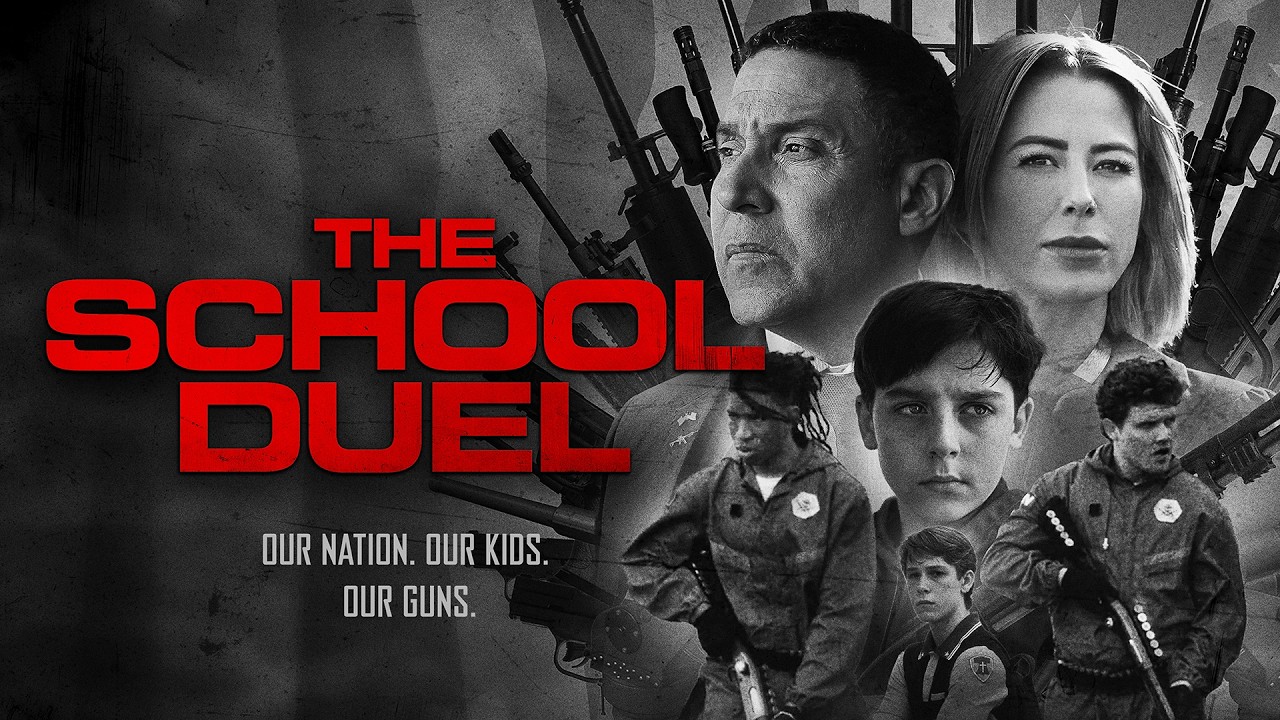
In a near-future Florida, 13-year-old Sammy Miller lives in a society where gun control has disappeared and school shootings have become so normalized that the government proposes a grotesque solution: identify potentially dangerous boys and place them inside a televised fight-to-the-death competition called the School Duel. Bullied, isolated and increasingly attracted to ideas of strength, patriotism and recognition, Sammy secretly volunteers despite his mother Beth’s objections.
Writer-director Todd Wiseman Jr. turns the familiar dystopian death-match structure into something deliberately closer to contemporary American life. Rather than constructing an elaborate futuristic world, the film makes schools, political rhetoric, social media, nationalism and adolescent insecurity the infrastructure of its dystopia, asking what happens when a society stops protecting vulnerable young people and begins transforming their anger into spectacle.
➡️ Movie Insight: The School Duel makes dystopian violence disturbing precisely because its world does not feel very distant from the present. Sammy is not introduced as a conventional action hero but as an alienated child searching for recognition in systems that know how to exploit him. The film turns that vulnerability into the emotional foundation of its political nightmare.
Why This Movie Matters Right Now: When Institutions Turn Adolescent Anger Into Power
The film’s most unsettling idea is not simply that children are armed, but that adults have built institutions capable of turning adolescent frustration into something politically useful. Sammy encounters bullying, isolation, masculinity, patriotism, online influence and institutional indifference before the competition offers him something none of those environments have provided: the feeling that he finally matters.
That makes The School Duel particularly relevant to contemporary conversations about how young people form identities in environments saturated with ideological messaging and mediated attention. The movie exaggerates those pressures into dystopian fiction, but its central question remains recognizable: what happens when belonging, visibility and purpose become easier to find through extremity than through family, school or community?
➡️ Why It Matters: The film treats youth violence as the endpoint of a larger system rather than an isolated act. It shows how vulnerable young people can become receptive to institutions that transform insecurity into identity and aggression into status. That makes its dystopian premise function less as escapism than as a warning about who reaches alienated adolescents first.
Should You Watch It?: A Bleak Dystopian Thriller Designed to Provoke
The School Duel is best suited to viewers comfortable with confrontational political science fiction rather than conventional action entertainment. Its premise promises a deadly competition, but much of its impact comes from watching Sammy’s environment gradually prepare him psychologically for that competition, making the build-up as important as the eventual violence.
The stark black-and-white photography reinforces the film’s severe atmosphere, while Kue Lawrence gives the story an emotional center that prevents Sammy from becoming merely a symbol. The movie can be blunt in its political messaging, and some viewers may find parts of its pacing or satire deliberately uncomfortable, but that discomfort is integral to the experience Wiseman is constructing.
➡️ Viewing Recommendation: Watch it for provocative dystopian cinema rather than escapist battle-royale spectacle. Its strongest material comes from the relationship between adolescent vulnerability and institutional manipulation. Viewers drawn to politically charged independent thrillers should find considerable material to discuss after the credits.
Why Everyone Is Talking About It?: Festival Recognition Turned a Provocative Debut Into a Discovery
The School Duel built credibility through an international festival journey that included Deauville, Miami, Sunscreen and Fantasia. At the 50th Deauville American Film Festival, it won the CANAL+ Special 50th Anniversary Jury Prize, while its 2025 Fantasia screenings sold out, giving Wiseman’s feature debut the kind of festival momentum that can transform an independently produced genre film into a broader discovery.
The reaction is understandable because the film combines an immediately communicable high-concept premise with a subject audiences are likely to debate. Its mixture of children, guns, televised competition, political propaganda and contemporary American anxieties creates a film that is difficult to discuss without also discussing the society it is exaggerating.
➡️ Viral Potential: The premise can be explained in a sentence, but its implications generate a much longer conversation. Festival recognition and provocative subject matter give the film strong word-of-mouth potential among genre and independent-film audiences. Its greatest discovery advantage is that viewers are likely to debate what the dystopia says about the present rather than simply whether the competition itself is entertaining.
Why The School Duel Stands Out: A Battle Royale Built From American Institutions
The School Duel inevitably recalls survival narratives in which young people are forced into lethal competition, but Wiseman changes the meaning of that familiar structure by placing it inside recognizable American institutions. Schools, government, religion, media spectacle, patriotism and gun culture are not background decoration; they are mechanisms through which the competition becomes socially acceptable.
Its black-and-white cinematography strengthens that distinction. Instead of the polished futurism associated with many dystopian franchises, the monochrome imagery gives the world a severe, almost historical quality, allowing contemporary political iconography and militaristic spectacle to feel simultaneously futuristic and disturbingly familiar.
➡️ Cinema Insight: The film’s originality comes less from inventing the death-match format than from relocating it into recognizable American cultural systems. Its dystopia is constructed from institutions audiences already understand rather than futuristic technology. That proximity gives a familiar genre mechanism renewed political and emotional force.
Movie Trend: Dystopian Thriller — When Institutions Turn Young People Into Weapons
A growing strength of contemporary dystopian cinema is its movement away from remote speculative worlds toward futures assembled from recognizable present-day tensions. The School Duel belongs to that tradition by asking what happens when institutions that should protect young people instead absorb their anger, loneliness and desire for belonging.
Within that framework, the deadly competition becomes more than a survival-game device. It represents a system capable of converting troubled adolescents into public symbols, entertainment and instruments of political messaging, making institutional manipulation rather than individual evil the film’s deeper source of horror.
➡️ Movie Trend: Contemporary dystopian thrillers are increasingly bringing speculative collapse closer to recognizable social institutions and everyday life. The School Duel embodies that movement by turning adolescent alienation into material for a government-controlled spectacle. Its approach suggests that politically engaged genre filmmaking can make dystopia more immediate by showing present systems pushed only a few disturbing steps further.
Viewer Profile: Political Dystopian Thriller Audience
Political Dystopian Thriller Audience — viewers attracted to speculative stories that use extreme fictional scenarios to examine contemporary institutions, social behavior and systems of power. They are likely to appreciate films where genre tension operates alongside political or cultural interpretation rather than existing purely as entertainment.
A secondary audience comes from festival and independent-film viewers interested in provocative debut filmmaking, particularly movies that use strong formal choices and genre conventions to generate discussion.
|
Political Dystopian Thriller Audience — viewers drawn to speculative stories about institutional power, social breakdown and manipulation |
|
|
Independent Genre Film Audience — viewers interested in provocative low-budget filmmaking, festival discoveries and unconventional genre cinema |
|
|
18–44 — adult viewers strongly engaged with contemporary thrillers, dystopian storytelling and socially driven genre cinema |
|
|
Broad appeal, with strongest fit determined by genre interest rather than gender |
|
|
Broad; economic position is not a defining audience factor |
|
|
Film-aware, digitally connected and interested in contemporary cultural, social and political conversations |
|
|
Discovers movies through festivals, genre coverage, streaming platforms, reviews, trailers and strong word-of-mouth |
➡️ Audience Insight: The strongest audience is viewers who want dystopian thrillers to engage with recognizable contemporary anxieties. They expect provocative ideas, moral discomfort and a cinematic premise capable of generating discussion beyond the plot. The School Duel satisfies that expectation by making institutional manipulation as important as survival itself.
What This Movie Means for the Industry: High-Concept Independent Cinema Can Compete Through Ideas
The School Duel demonstrates how independent genre filmmaking can create scale without attempting to reproduce blockbuster economics. Its central concept — children participating in a government-sanctioned death match — immediately establishes a large social world, while the production concentrates its resources on characters, iconography, atmosphere and the eventual competition.
Its festival trajectory also shows the continuing value of positioning provocative genre films where both cinematic craft and conversation potential can be discovered. Winning the CANAL+ Special 50th Anniversary Jury Prize at Deauville before moving through festivals including Miami and Fantasia gave the project credibility beyond conventional genre channels, while Altered Innocence subsequently brought the film to US audiences.
➡️ Industry Insight: Independent genre films can create cultural scale through concepts rather than production scale alone. Festival recognition can help politically provocative films cross between specialist genre audiences and broader independent-cinema communities. The School Duel shows why a distinctive premise, recognizable social tension and confident visual identity can become meaningful distribution assets.
Creative Analysis: Turning a Child’s Search for Belonging Into Dystopian Horror
The film’s creative strength comes from refusing to begin with the spectacle promised by its title. Wiseman first builds the emotional and ideological environment around Sammy, allowing the competition to emerge as the culmination of forces that have already been shaping him.
That decision gives the movie’s violence a different function. The School Duel is frightening not simply because children are placed in danger, but because the adults and institutions surrounding them have constructed a moral language capable of presenting that danger as purpose, patriotism and social necessity.
Storytelling: The Competition Begins Long Before the Battlefield
The narrative is structured around Sammy’s movement from alienated student to willing participant. His experiences at school, at home and within the wider ideological environment establish why the promise of recognition attached to the Duel can become seductive.
This makes the competition the payoff to a psychological process rather than merely the film’s action centerpiece. By the time Sammy enters the arena, the more disturbing transformation has already occurred: he has learned to interpret participation as an opportunity to become visible.
Direction: Making Dystopia Feel Uncomfortably Familiar
Wiseman avoids creating a distant technological future. Instead, his direction draws dystopia from familiar spaces and symbols — classrooms, homes, uniforms, political messaging, weapons, patriotic rituals and media presentation.
The approach keeps the film’s speculative elements anchored in recognizability. The audience is therefore encouraged to measure the fictional world against the present rather than dismiss it as an entirely invented society.
Performances: Kue Lawrence Keeps the Politics Human
Kue Lawrence carries the film’s central contradiction: Sammy must appear vulnerable enough to understand his alienation while also making his attraction to the competition psychologically credible. His performance allows the character’s anger and need for recognition to coexist with the fact that he remains a child.
Christina Brucato’s Beth provides an important counterweight as Sammy’s mother, while Oscar Nuñez’s Governor Ramiro represents the institutional confidence behind the system. The ensemble consequently places Sammy between personal concern and public machinery, strengthening the sense that his individual crisis is being absorbed by something much larger.
Visual Style: Black and White Turns the Future Into a Warning
Cinematographer Kyle Deitz’s black-and-white photography is one of the film’s clearest distinguishing choices. The absence of color strips the near-future setting of conventional science-fiction gloss and gives its schools, political imagery and militaristic rituals a harder, more severe texture.
The visual language also creates a sense that the events could belong to several historical periods at once. Rather than presenting dystopia as visually new, the film makes authoritarian spectacle look disturbingly old and familiar.
Themes: Belonging Becomes the Most Dangerous Recruitment Tool
Beneath its gun-control satire, The School Duel is fundamentally interested in how people and institutions compete for the loyalty of vulnerable young people. Sammy’s desire to be respected, recognized and connected makes him susceptible to a system capable of reframing violence as identity.
That makes belonging one of the film’s most unsettling themes. The government does not merely give Sammy a weapon; it gives him a narrative in which participation promises to transform insignificance into purpose.
What Makes It Different: The Dystopia Starts at School
Many survival dystopias construct enormous fictional political systems before introducing their young protagonists. The School Duel reverses that emphasis by beginning with an adolescent’s recognizable emotional environment and allowing the larger political nightmare to grow around it.
That choice gives the movie a more intimate point of entry. Its most frightening proposition is not simply that a government could create the Duel, but that a lonely child could encounter enough failures beforehand to believe entering it might finally solve something.
➡️ Creative Insight: The film’s most effective creative decision is connecting a spectacular dystopian premise to an intimate adolescent vulnerability. Its monochrome imagery and recognizable institutions prevent the fictional future from feeling safely remote. The result is a genre film whose political argument works because the audience first understands why one child might want to enter the nightmare.
If You Liked The School Duel (2024): Dystopian Cinema Where Society Turns Violence Into a System
These recent films similarly examine environments in which violence becomes institutional, ideological or socially normalized. Each approaches that anxiety differently, but all use thriller conventions to ask what happens when systems designed to organize society begin producing the danger themselves.
The Long Walk (2025) by Francis Lawrence: When Survival Becomes National Spectacle
Teenage boys enter a government-controlled endurance competition in a dystopian America where falling behind means death. Like The School Duel, the premise transforms young male vulnerability into a ritualized public contest administered by authority.
➡️ Why It Connects: Both films place young men inside deadly competitions normalized by authoritarian systems. Their survival mechanisms become examinations of obedience, masculinity and the political value of spectacle. The Long Walk is the closest contemporary companion to The School Duel’s central dystopian mechanism.
The Siege at Thorn High (2025) by Joko Anwar: When Schools Become Battlegrounds
Joko Anwar’s dystopian action thriller traps a substitute teacher inside a violent Jakarta school as wider social unrest transforms the institution into a battleground. The setting makes education, youth violence and social fracture inseparable from the film’s escalating survival story.
➡️ Why It Connects: Both films transform schools from places of protection into environments shaped by systemic violence. Each uses young people and institutional failure to explore a society moving toward something more dangerous. The Siege at Thorn High expands that tension from the school itself into a wider picture of social breakdown.
Civil War (2024) by Alex Garland: When Political Division Becomes Physical Reality
Alex Garland imagines a near-future United States already consumed by internal war, following journalists attempting to document a country in which institutional and political fracture has become everyday violence.
➡️ Why It Connects: Both movies take recognizable American tensions and extend them into near-future dystopian scenarios. Neither requires futuristic technology because political behavior itself supplies the speculative threat. Civil War broadens The School Duel’s localized warning into the image of an entire country living with the consequences of institutional collapse.
➡️ If You Liked Insight: These films reflect a contemporary dystopian cinema increasingly interested in institutions that normalize violence rather than distant technological futures. Their worlds become frightening because the mechanisms of control remain culturally recognizable. The School Duel belongs to this movement by locating its warning at the intersection of childhood, education, politics and spectacle.
Final Verdict: A Provocative Dystopia That Makes Childhood Its Battlefield
The School Duel works best when it remains close to Sammy and examines the emotional conditions that make its outrageous premise possible. Kue Lawrence’s vulnerable central performance, Wiseman’s uncompromising concept and Kyle Deitz’s monochrome cinematography give the film a distinctive identity even when its political argument intentionally operates with little subtlety.
Its most memorable achievement is turning the familiar battle-royale structure away from fantasy and toward recognizable American institutions. The result is uncomfortable by design: a dystopian thriller in which the most frightening development is not that children are killing one another, but that adults have created a society capable of calling the process a solution.
➡️ Final Verdict: The School Duel is a confrontational independent dystopian thriller with a strong visual identity and an intentionally provocative political premise. Its most effective weapon is Sammy’s vulnerability rather than the spectacle of the competition itself. The film deserves attention as a feature debut willing to make genre entertainment deeply uncomfortable.
Quick Facts: The School Duel at a Glance
|
Kue Lawrence, Christina Brucato, Oscar Nuñez |
|
|
Jamad Mays, Michael Sean Tighe, Eugenie Bondurant, Hudson Meek |
|
|
Not confirmed in supplied material |
|
|
Todd Wiseman Jr., Christa Boarini, Bryan Gaynor, Bobby Marinelli |
|
|
Deauville Film Festival 2024; Miami Film Festival 2025; Sunscreen Film Festival 2025; Fantasia 2025 |
|
|
CANAL+ Special 50th Anniversary Jury Prize at Deauville; additional Sunscreen recognition |
|
|
Dystopian Thriller — When Institutions Turn Young People Into Weapons |
|
|
Sammy Miller; Beth Miller |
|
|
An alienated 13-year-old enters a state-sanctioned deadly competition promising recognition and purpose |
|
|
A government responds to school shootings by converting potentially violent boys into participants in televised lethal competition |
|
|
Youth alienation, institutional manipulation, gun violence, masculinity, propaganda, belonging, nationalism, spectacle |
|
|
A provocative black-and-white dystopian thriller that brings the battle-royale format disturbingly close to contemporary American institutions |
Final Insights: Dystopian Cinema Is Moving the Future Closer to the Present
The School Duel reflects a significant direction in contemporary dystopian filmmaking: speculative worlds no longer need to look technologically futuristic to feel frightening. By building its nightmare from schools, political rhetoric, social media, patriotic symbolism and institutional failure, the film demonstrates how genre cinema can transform familiar cultural structures into mechanisms of speculative horror.
That approach could become increasingly important for independent filmmakers because recognizable dystopia requires ideas more than enormous production budgets. When filmmakers push existing social tensions just far enough to reveal their possible consequences, science fiction becomes a way of interrogating the present rather than predicting a remote future.
➡️ Final Insight: Contemporary dystopian cinema is becoming more powerful when the distance between fictional collapse and everyday reality becomes smaller. The School Duel exemplifies that shift by turning familiar institutions into the machinery of its nightmare. Its broader significance lies in showing how independent genre cinema can make social warnings feel immediate without needing to build an entirely unfamiliar world.






Leave a Reply