
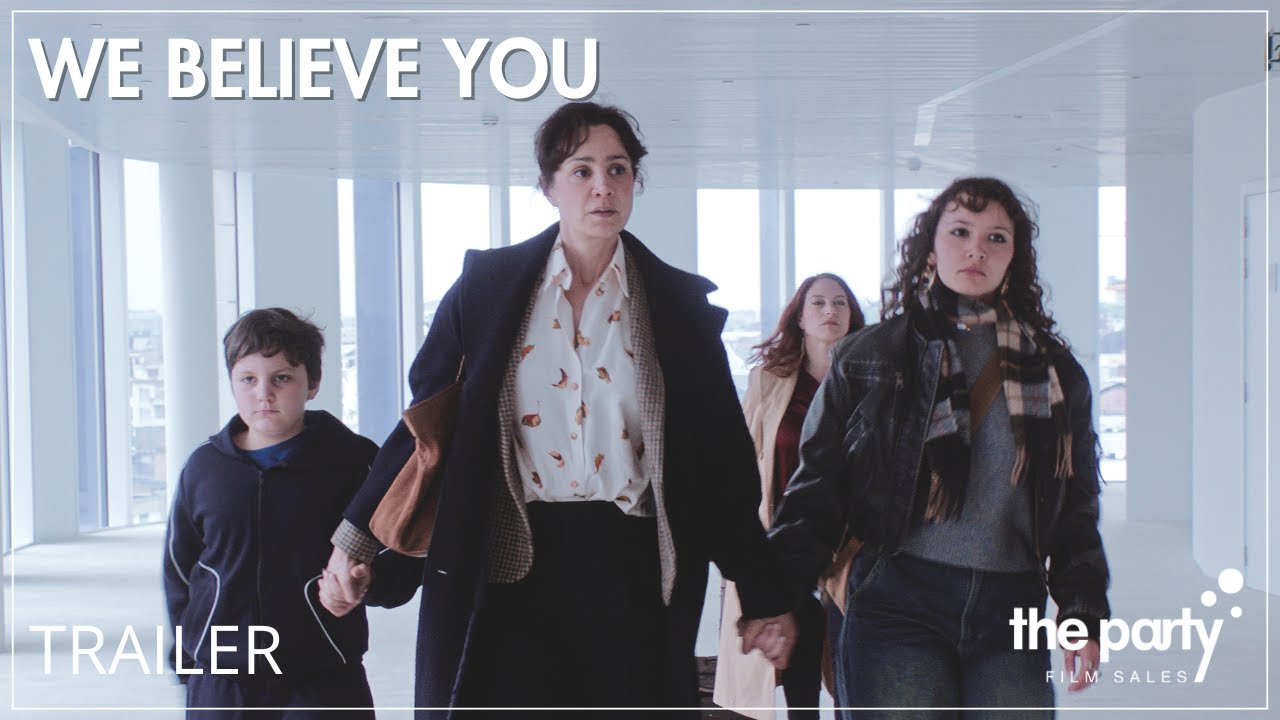
Belgium | 2025 | 78 min | Drama
A Mother Fighting to Protect Her Children
Alice enters a courtroom knowing that what happens next could determine whether she can protect her children. Their custody is being questioned, their father is part of the proceedings, and Alice must make the children’s fears heard within a legal system that demands evidence, restraint and precision at the very moment when the emotional stakes could hardly be higher.
Charlotte Devillers and Arnaud Dufeys strip the custody drama down to its most uncomfortable essentials. Much of the film is concentrated inside the courthouse, including an extended central sequence unfolding almost in real time. That restriction makes the legal process itself a source of tension: Alice cannot escape, reset the conversation or afford to say the wrong thing when the safety of her children may depend upon whether the people in the room believe her.
➡️ Key Takeaway: We Believe You transforms a custody hearing into an intensely human suspense story where being believed can become the difference between protection and further harm.
Should You Watch It?: A Devastating Legal Drama Where Listening Becomes an Act of Protection
We Believe You is particularly compelling for viewers drawn to socially grounded dramas that create tension without conventional thriller machinery. The film’s 78-minute running time and concentrated setting make the experience unusually immediate. Instead of repeatedly leaving the courtroom to explain the characters’ histories, Devillers and Dufeys force viewers to experience the exhausting mechanisms of the hearing alongside Alice.
Myriem Akheddiou’s central performance is crucial to that approach. Alice has to advocate fiercely for her children while operating inside an institution where emotional desperation can itself affect how a person is perceived. The directors also incorporated real-life lawyers into the production, reinforcing the authenticity of the legal exchanges and making the courtroom feel less like dramatic scenery than an institution with real power over this family.
➡️ Key Takeaway: Watch We Believe You for an emotionally demanding courtroom drama that creates suspense from a frighteningly simple question: what happens when protecting your children depends on convincing strangers to believe you?
Why Everyone Is Talking About It?: A 78-Minute Debut Became One of Belgium’s Most Acclaimed Recent Dramas
We Believe You began its international journey at the 2025 Berlin International Film Festival, where it screened in the new Perspectives competition and received a Special Mention for Best First Feature. Its festival momentum continued through 2025, including a major showing at Seville, where it won the Golden Giraldillo for Best Film as well as Best Actress for Myriem Akheddiou and Best Screenplay for Devillers and Dufeys.
That recognition continued at home in 2026. The film became a major winner at Belgium’s René du Cinéma awards, taking Best Film, Best Director, Best Actress, Best Screenplay and other prizes. Yet the reason the film resonates goes beyond awards: its tightly controlled courtroom format transforms questions around custody, children’s testimony, institutional responsibility and the presumption of innocence into an experience where viewers are forced to confront how difficult believing and protecting vulnerable people can become inside formal systems.
➡️ Key Takeaway: We Believe You has emerged as a significant Belgian debut because it turns an urgent social issue into gripping cinema without sensationalizing it—making the simple act of listening feel consequential, difficult and potentially life-changing.
Movie Trend: Family & Justice — Courtroom Dramas Are Turning Protection Into a Battle to Be Believed
We Believe You sits primarily within Family, with Justice, Childhood and Power Dynamics defining its social urgency. Alice is not entering court to win an abstract legal argument; she is trying to convince an institution that her children’s experiences must be taken seriously. That transforms the custody hearing into something more unsettling than a conventional courtroom confrontation, because the consequences extend directly into the children’s safety and future.
The film belongs to a strand of contemporary social-realist cinema interested in the distance between institutional procedure and lived experience. Courts require testimony, evidence and controlled argument, while families experiencing fear or abuse rarely arrive in such orderly form. By concentrating the drama around that collision, Charlotte Devillers and Arnaud Dufeys make listening itself a question of power: who is considered credible, whose account carries authority and what happens when institutional doubt delays protection?
➡️ Key Takeaway: We Believe You turns family court into a struggle over credibility, showing how protecting vulnerable children can depend on whether institutions are prepared to hear what a family is trying to tell them.
➡️ Movie Trend: Family & Justice
Who Should Watch It? (Audience Profile): For Viewers Who Want Social Drama to Feel Immediate and Uncomfortably Real
|
Social-realist drama, courtroom drama and European arthouse audiences |
|
|
Festival viewers and audiences interested in family, justice, childhood and institutional power |
|
|
Middle to upper-middle income, culturally engaged audience |
|
|
Socially aware, culturally curious and interested in issue-driven European cinema |
|
|
Film festivals, arthouse cinemas, curated streaming platforms and critically acclaimed international films |
The strongest audience is likely to be viewers who appreciate films capable of generating suspense from human behavior rather than conventional thriller mechanics. At only 78 minutes, We Believe You is concentrated rather than expansive, placing viewers close to Alice as language, reactions and institutional procedure acquire enormous significance.
It should also appeal to audiences interested in films examining systems from the perspective of ordinary people forced to navigate them. The legal environment matters, but the emotional center remains the family. That distinction prevents the film from becoming primarily a procedural; the courtroom is compelling because viewers understand what Alice believes could happen outside it.
➡️ Key Takeaway: We Believe You is for viewers who want socially engaged cinema that turns a seemingly ordinary institutional process into an emotionally immediate question of protection and responsibility.
What This Movie Means for the Industry: Social Realism Is Becoming More Immersive, Focused and Urgent
We Believe You demonstrates how a relatively small-scale film can generate substantial dramatic intensity by restricting rather than expanding its canvas. A short runtime, limited locations and concentrated courtroom interaction allow performance and dialogue to carry the tension. For independent European filmmakers, that approach shows how formal restraint can become a creative advantage when the human stakes are sufficiently strong.
Its festival trajectory reinforces the continuing appetite for socially engaged filmmaking that avoids turning difficult subjects into conventional melodrama. The film received a Special Mention in Berlinale Perspectives before winning Best Film, Best Actress and Best Screenplay at Seville, followed by major recognition in Belgium. That progression suggests that intimate stories about family and institutional responsibility can travel internationally when their underlying conflict—the struggle to make vulnerable people heard—is universally recognizable.
➡️ Key Takeaway: We Believe You shows the continuing strength of concentrated social realism: small spaces, short runtimes and ordinary institutional encounters can produce powerful cinema when the consequences for the people inside them are enormous.
Creative Analysis: A Custody Hearing Becomes a Test of Who the System Chooses to Believe
We Believe You builds its creative power from restriction. Charlotte Devillers and Arnaud Dufeys concentrate the drama around a family-court hearing, removing many of the narrative escapes a more conventional film might provide. Alice cannot simply walk away from the conflict; she has to remain inside a formal process where every statement, interruption and reaction can influence how her ability to protect her children is judged.
That concentration changes the nature of suspense. The film does not need a hidden villain or elaborate revelation because the uncertainty comes from whether Alice can make herself understood before the hearing ends. The courtroom becomes an emotional pressure chamber in which credibility itself functions like evidence, making the audience acutely aware of how differently fear can look when translated into institutional language.
➡️ Key Takeaway: We Believe You turns legal procedure into psychological suspense by making Alice’s credibility—and her children’s protection—feel inseparable.
Storytelling: Real-Time Pressure Makes Every Word Carry Consequences
The screenplay strips the story down to an immediate objective: Alice needs the court to understand why she believes her children require protection. That clarity allows the filmmakers to avoid unnecessary narrative complication. Instead of building toward a conventional courtroom twist, tension accumulates through testimony, questions and the uncomfortable possibility that something essential could be misunderstood.
The near-real-time approach intensifies that vulnerability. Audiences receive limited opportunities to step outside the hearing and reassess what is happening, creating the feeling of being trapped within the same institutional timeframe as Alice. The result is storytelling where a sentence spoken badly can feel as consequential as an action sequence in a thriller.
➡️ Key Takeaway: The film creates urgency through language rather than plot twists, making every opportunity to speak feel like an opportunity that cannot be wasted.
Direction: Charlotte Devillers and Arnaud Dufeys Turn Restraint Into Tension
Devillers and Dufeys resist sensationalizing the subject. Their direction remains closely focused on behavior, speech and the shifting dynamics between people occupying the same institutional space. That restraint is essential because overt manipulation could easily diminish the credibility of material concerned precisely with questions of testimony and belief.
Their decision to work with legal professionals alongside professional actors adds another layer of naturalism to the proceedings. Instead of making the courtroom behave according to familiar cinematic conventions, the filmmakers emphasize its procedural rhythms—the waiting, questioning, interruptions and formal language that can appear ordinary while determining extraordinarily important outcomes.
➡️ Key Takeaway: Devillers and Dufeys make institutional realism the source of suspense, proving that a courtroom does not need theatrical speeches to feel terrifyingly consequential.
Performances: Myriem Akheddiou Makes Emotional Control Feel Like a Fight for Survival
Myriem Akheddiou carries much of the film’s emotional weight as Alice. The performance requires an especially difficult balance: Alice has every reason to be emotionally overwhelmed, yet she operates inside an environment where losing control could affect how other people evaluate her credibility. Akheddiou therefore makes restraint itself dramatically visible.
Natali Broods as the judge and Laurent Capelluto as Goossens help establish the competing forces surrounding Alice without reducing the proceedings to simplistic confrontation. The effectiveness of the ensemble comes from the uncertainty created between what characters feel, what they are willing to say and what the legal environment allows them to establish.
➡️ Key Takeaway: Akheddiou makes Alice’s self-control one of the film’s strongest sources of tension—the more desperately she needs to be heard, the more carefully she must communicate that desperation.
Cinematography & Visual Style: The 1.33:1 Frame Makes the Courtroom Feel Impossible to Escape
The film’s 1.33:1 aspect ratio gives its concentrated courtroom setting additional psychological force. The narrower frame keeps bodies and faces prominent while limiting the visual space around them, reinforcing the sensation that Alice has very little room—physically or emotionally—to escape the proceedings.
Close observation becomes particularly important in a story concerned with credibility. Facial expressions, hesitation and reactions carry information alongside dialogue, encouraging viewers to study people as carefully as they listen to them. The camera consequently functions almost like another participant in the hearing, watching for the emotional evidence that formal procedure cannot easily record.
➡️ Key Takeaway: The restricted frame visually reinforces the film’s central pressure: Alice is trapped inside a process where there is little space to hide, retreat or make a mistake.
Themes & Messages: Being Heard Is Not the Same as Being Believed
The central theme of We Believe You is contained within its title. People can speak, institutions can listen and testimony can enter the official record without genuine belief necessarily following. The film explores the dangerous distance between hearing someone’s account and accepting that the account requires action.
That distinction becomes especially urgent when children are involved. Adults control the institutional mechanisms through which children’s experiences are interpreted, meaning protection depends partly on whether those adults recognize vulnerability correctly. The film consequently asks a difficult question about responsibility: when uncertainty exists, how should institutions balance procedural fairness against the potential consequences of failing to protect someone?
➡️ Key Takeaway: We Believe You argues that listening only becomes meaningful when institutions are prepared to recognize vulnerability and respond to what they hear.
What Makes This Movie Different?: A Courtroom Drama Without the Comfort of a Conventional Verdict
What separates We Believe You from many legal dramas is its refusal to transform family court into theatrical entertainment. There are no grand jury speeches or elaborate investigative revelations driving the experience. Instead, Devillers and Dufeys focus on something more ordinary and potentially more disturbing: people attempting to communicate deeply personal experiences through an institutional process designed to evaluate them.
Its compact 78-minute runtime strengthens that distinction. The film enters the crisis, keeps viewers close to it and avoids diluting the emotional pressure through unnecessary subplots. That economy gives the experience an almost documentary immediacy while keeping Alice’s central objective—protecting her children—constantly visible.
➡️ Key Takeaway: What makes We Believe You distinctive is its refusal to make justice spectacular—the film finds its intensity in the frighteningly ordinary process of deciding whose words will be believed.
If You Liked We Believe You (2025): Recent Dramas Where Institutions Decide Who Gets Heard
Love Me Tender (2025) by Anna Cazenave Cambet
Love Me Tender is the closest recent companion to We Believe You because it also places motherhood inside a painful custody conflict. Vicky Krieps plays Clémence, whose relationship with her son is threatened after her separation and decision to live more openly. What begins as personal reinvention develops into a struggle against a family-court process capable of determining when and how she can remain part of her child’s life.
Where We Believe You compresses institutional pressure into an intensely concentrated hearing, Love Me Tender follows the longer emotional consequences of a custody battle. Both films are particularly interested in the burden placed on mothers who must simultaneously experience distress and demonstrate that distress in ways institutions consider credible.
Julie Keeps Quiet (2024) by Leonardo Van Dijl
Julie Keeps Quiet approaches institutional responsibility from another direction. A talented teenage tennis player finds herself at the center of an investigation involving her coach, yet chooses not to speak while the adults and institution surrounding her attempt to determine what has happened.
The connection to We Believe You lies in what institutions do when vulnerable people cannot—or do not—communicate their experiences in the form adults expect. Both films resist easy emotional exposition and instead make silence, observation and uncertainty central to understanding power.
All We Imagine as Light (2024) by Payal Kapadia
Payal Kapadia’s All We Imagine as Light moves away from the courtroom but provides another exceptional example of social realism built around women’s everyday experiences rather than dramatic sensationalism. Through three women in Mumbai, the film examines relationships, housing insecurity, work and personal freedom with the same confidence in observation and emotional restraint that makes We Believe You so effective.
It is the recommendation for viewers most attracted to the filmmaking rather than specifically the custody story. Both films demonstrate how contemporary social realism can make apparently ordinary circumstances feel politically significant simply by staying close enough to the people living through them.
➡️ Key Takeaway: Start with Love Me Tender for the closest custody and motherhood connection, Julie Keeps Quiet for another story about institutional responsibility and vulnerable testimony, and All We Imagine as Light for equally restrained, human-centered social realism.
Final Verdict: A Courtroom Drama Where Being Believed Becomes the Highest Possible Stake
We Believe You achieves remarkable intensity with very little conventional dramatic machinery. Charlotte Devillers and Arnaud Dufeys reduce the story to people, testimony, institutional procedure and a mother attempting to make herself understood. At just 78 minutes, the film has almost no narrative excess; every exchange matters because Alice believes the consequences will extend directly into her children’s lives.
Myriem Akheddiou is fundamental to why that restraint works. Alice must communicate fear, determination and frustration without allowing those emotions to overwhelm her ability to function inside the hearing. The performance makes an uncomfortable contradiction visible: the more emotionally devastating the circumstances become, the more carefully she may need to present herself to remain credible.
The film’s greatest achievement is ultimately its refusal to transform institutional failure into spectacle. There are no grand courtroom theatrics required because the central question is already powerful enough: when someone says a child needs protection, what does it take for the system to believe them? That simplicity gives We Believe You an urgency extending far beyond its courtroom.
➡️ Final Verdict: 4.5/5 — A fiercely controlled and emotionally devastating Belgian drama that turns the act of listening into a question of protection, responsibility and justice.
Quick Facts: A 78-Minute Courtroom Drama Where Every Word Can Change a Family’s Future
|
Drama / Courtroom Drama / Social Realism |
|
|
Family, custody, childhood, justice, protection and institutional power |
|
|
Charlotte Devillers, Arnaud Dufeys |
|
|
Charlotte Devillers, Arnaud Dufeys |
|
|
Myriem Akheddiou, Laurent Capelluto, Natali Broods, Ulysse Goffin, Adèle Pinckaers |
|
|
Berlinale Perspectives Special Mention; Seville Golden Giraldillo; major 2026 Belgian René Award wins |
➡️ Key Takeaway: We Believe You is essential contemporary social realism because it transforms an ordinary custody proceeding into an extraordinarily tense examination of belief, childhood protection and the enormous power institutions hold over vulnerable families.






Leave a Reply