
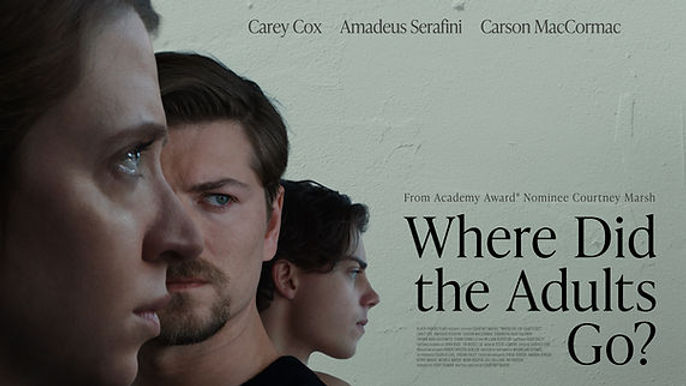
US | 2025 | 89 min | Drama
Going Home Brings Every Family Problem Back With You
Every year, Cynthia, Bryce and Miles return to their family summer home on the anniversary of their parents’ deaths. What should be a ritual of remembrance becomes something far more volatile when Cynthia proposes selling the property, forcing three siblings who already struggle to understand each other to decide what their shared past is actually worth.
Courtney Marsh turns that practical decision into the trigger for a much larger emotional confrontation. The house carries memories of their parents, but it also contains old resentments, childhood roles and competing ideas about what each sibling deserves from the family. Selling it could help Cynthia build her future, but agreeing to sell also means asking everyone else to surrender something they may not be ready to lose.
➡️ Movie Insight: Where Did the Adults Go? makes one family property the battleground for years of unresolved emotion. The siblings are adults, but returning home pulls them back toward conflicts they never completely escaped. The argument about selling the house gradually becomes an argument about the family itself.
Why This Movie Matters Right Now: Inheriting the Family Home Can Mean Inheriting the Conflict
Family property carries two kinds of value: financial value and emotional value. Where Did the Adults Go? places those competing meanings directly against each other as Cynthia’s need for financial stability collides with Bryce’s resistance to selling a place connected to their parents and their shared history.
That makes the movie especially effective as a contemporary adult-family drama. Homes are assets, inheritances and potential sources of financial security, but they are also repositories of memory. Once siblings inherit those spaces together, deciding what happens next can expose dramatically different ideas about responsibility, fairness, grief and who has the right to determine the family’s future.
➡️ Why It Matters: The movie understands that inherited property is rarely only property. Cynthia sees an opportunity to move forward while the house means something different to her brothers. Money forces emotional questions into a decision the siblings can no longer avoid.
Should You Watch It?: Come for a Family Argument That Keeps Getting More Personal
Where Did the Adults Go? is designed for viewers who prefer performance-driven family dramas over plot-heavy storytelling. Much of its tension comes from conversation, confrontation and the gradual revelation of why Cynthia, Bryce and Miles have such different understandings of their childhood, their parents and one another.
The deliberately contained approach makes the movie feel like a pressure cooker. Instead of constantly introducing new events, Marsh keeps returning attention to the siblings and allows seemingly practical disagreements to reveal much deeper wounds. The attraction is watching three people who know exactly where each other’s emotional weaknesses are attempt to decide whether being family is enough to keep them together.
➡️ Viewing Recommendation: Watch Where Did the Adults Go? for its performances and increasingly uncomfortable sibling confrontations. It is intimate, dialogue-driven and deliberately restrained rather than conventionally plot-heavy. Viewers who enjoy dysfunctional-family dramas should find plenty to unpack after the final argument ends.
Why Everyone Is Talking About It?: Courtney Marsh Turns Documentary Observation Toward Family Drama
Where Did the Adults Go? marks an important transition for Courtney Marsh, previously known for documentary filmmaking and particularly the Oscar-nominated documentary short Chau, Beyond the Lines. Her narrative feature debut retains an observational quality, placing Cynthia, Bryce and Miles in a shared environment and allowing their competing perspectives to collide without reducing the family conflict to a simple hero-versus-villain dynamic.
The film has also built conversation around the intensity of its performances and its willingness to leave some emotional questions unresolved. Carey Cox, Amadeus Serafini and Carson MacCormac carry most of that pressure, while the film’s independent production history through Film Independent and its wider digital availability give this intimate character drama an opportunity to find audiences beyond its initial release.
➡️ Viral Potential: The movie’s strongest conversation driver is recognition rather than spectacle. Arguments about siblings, parents, inheritance and the family home invite viewers to decide whose perspective they understand most. That disagreement can keep the film’s family conflict alive after audiences finish watching.
Why Where Did the Adults Go? Stands Out: Nobody Remembers the Same Family
Cynthia, Bryce and Miles share parents, a house and years of family history, but that does not mean they experienced any of those things in the same way. One of the film’s most interesting ideas is that siblings can emerge from the same childhood carrying completely different interpretations of what happened and what they owe one another afterward.
Cynthia’s position adds another dimension. Her financial pressures and experience as a disability activist shape what moving forward means for her, while Bryce approaches the property from another perspective and Miles becomes caught between competing siblings while carrying problems of his own. The house brings those individual realities into direct competition.
➡️ Cinema Insight: Where Did the Adults Go? rejects the idea that one shared childhood creates one shared truth. Each sibling brings a different version of the family back into the house. The drama comes from discovering how difficult those versions are to reconcile.
Movie Trend: Sibling Rivalry — When the Family Home Tears Everyone Apart
Sibling rivalry becomes particularly powerful on screen when adult characters return to the spaces where their identities were originally formed. Careers, relationships and independence may have changed them, but walking back into a childhood home can immediately reactivate the hierarchy, resentment and emotional habits established years earlier.
Where Did the Adults Go? uses the proposed sale to make those invisible tensions tangible. Cynthia, Bryce and Miles cannot simply avoid one another because a decision has to be made, and the house cannot belong entirely to one person’s memory. Their inheritance keeps them connected even as their different needs threaten to pull them apart.
➡️ Movie Trend: Sibling Rivalry dramas are strongest when adulthood cannot erase childhood history. The family home gives old conflicts somewhere physical to return. Where Did the Adults Go? turns inheritance into the pressure point that forces three siblings to confront what they have never resolved.
Viewer Profile: Adults Who Know Family Arguments Never Stay About One Thing
The core audience is viewers attracted to intimate character dramas about complicated families rather than cleanly resolved conflicts. Anyone who has watched adult siblings fall back into childhood roles during holidays, funerals, inheritance discussions or returns to the family home will recognize the emotional territory immediately.
The film should also connect with audiences interested in stories about grief, disability, queer family life, financial pressure and the different ways adults construct identities after leaving home. Those themes broaden a deceptively small story without changing its central focus on three siblings attempting to understand one another.
|
Viewers of intimate dysfunctional-family and sibling dramas |
|
|
Independent-film audiences interested in grief, identity, disability and contemporary family relationships |
|
|
Broad adult audience with particular appeal to character-drama viewers |
|
|
Broad middle-income and professional audience |
|
|
Independent-cinema viewers interested in relationships, family psychology and socially grounded storytelling |
|
|
Character dramas, festival films, family stories, relationship films and dialogue-driven independent cinema |
➡️ Audience Insight: The film’s strongest audience connection comes from emotional familiarity. Viewers do not need to share this family’s exact circumstances to recognize how quickly an old sibling argument can become something much larger. The more complicated someone’s own relationship with family history is, the more recognizable the movie may feel.
What This Movie Means for the Industry: Small Family Dramas Can Still Create Big Emotional Stakes
Where Did the Adults Go? demonstrates how independent filmmakers can build an entire feature around a limited location, a small ensemble and one emotionally loaded decision. The house provides production economy while simultaneously becoming central to the story, meaning the film’s limitations and dramatic concept reinforce each other.
That model remains valuable for independent cinema. Instead of competing through scale, filmmakers can create intensity through recognizable relationships, strong actors and conflicts where every line of dialogue carries years of history. A family argument requires little spectacle when audiences understand that losing the argument could permanently change the relationship.
➡️ Industry Insight: Contained family dramas turn production limitations into creative advantages. A small cast can generate enormous tension when every relationship already contains history. Where Did the Adults Go? shows why emotionally specific storytelling remains one of independent cinema’s strongest competitive tools.
Creative Analysis: One House Holds an Entire Family History
Courtney Marsh uses confinement as an emotional device. Bringing Cynthia, Bryce and Miles together inside their parents’ summer home means the characters are surrounded by the very history they are attempting to discuss, making it difficult to separate the current property dispute from everything that happened before it.
The approach gives the film an almost theatrical concentration while retaining an observational visual sensibility. Conversations become confrontations, confrontations reveal memories and those memories repeatedly change how audiences understand the three people participating in the argument.
Storytelling: One Decision Opens Every Old Wound
Selling the house provides an elegantly simple narrative engine. Everyone understands the decision immediately, but every sibling has different reasons for approaching it, allowing Marsh to reveal character through disagreement rather than extensive external plotting.
The deciding vote also creates shifting emotional alliances. Cynthia and Bryce need Miles, but Miles has his own problems and perspective. The structure therefore prevents the youngest sibling from existing merely as a spectator while turning an apparently binary dispute into a more unstable three-way family struggle.
Direction: Courtney Marsh Observes Before She Judges
Marsh’s documentary background is particularly compatible with a story built around competing versions of reality. Rather than making the conflict entirely about determining which sibling is objectively right, the film can remain interested in how each person has constructed a version of the family that makes their own behavior understandable.
That approach also makes discomfort productive. The siblings can be selfish, wounded, defensive and loving within the same relationship because the film does not require them to become easily likable. Marsh is more interested in the emotional system connecting them.
Performances: Three Siblings Keep Changing the Balance of Power
Carey Cox gives Cynthia the determination necessary to initiate the conflict without reducing her motivation to money alone. Her desire for financial stability exists alongside larger questions about independence, accessibility, advocacy, marriage and what she believes she is entitled to ask from her family.
Amadeus Serafini gives Bryce the resistance needed to prevent the decision from becoming easy, while Carson MacCormac’s Miles occupies the unstable position between them. The trio works because no single sibling can control the conversation indefinitely; emotional power continually shifts as different grievances emerge.
Visual Style: The Family Home Becomes an Emotional Trap
The summer home initially represents continuity. It is the place where the siblings return every year to remember their parents, giving physical permanence to a family structure that death has already disrupted.
As the conflict escalates, that same permanence becomes claustrophobic. The house stops functioning simply as a nostalgic refuge and begins to feel like a container for everything the siblings have avoided saying. The more emotionally trapped they become, the more significant the possibility of selling it feels.
Themes: Grief, Inheritance, Disability and the Myth of Unconditional Family Love
Grief remains embedded in the siblings’ conflict even when they are arguing about other subjects. Their parents are gone, yet decisions about the house continue to give the absent generation enormous influence over the surviving family.
The film also asks whether family love should automatically survive every resentment, disagreement and perceived betrayal. Cynthia, Bryce and Miles remain connected biologically and historically, but the movie is interested in whether those connections create genuine obligation and what happens when different siblings define that obligation differently.
What Makes It Different: Nobody Gets to Be the Responsible Adult
The title contains the movie’s sharpest idea. Cynthia, Bryce and Miles may be adults, but adulthood has not delivered the certainty, emotional maturity or stability that children often imagine adults possess. They are still improvising through grief, money, relationships and family responsibility.
Returning home exposes that contradiction. Without their parents, the siblings have effectively inherited responsibility for deciding what the family becomes next, yet none of them possesses an unquestionable authority to make that decision. They have become the adults they were waiting for without necessarily feeling prepared for the role.
➡️ Creative Insight: The film makes adulthood feel less like an achievement than an ongoing negotiation. Cynthia, Bryce and Miles are simultaneously independent adults and children still reacting to their family history. The house forces those identities into the same room.
If You Liked Where Did the Adults Go? (2025): More Family Dramas Where Going Home Changes Everything
These films similarly bring fractured families into shared spaces where grief, memory and old resentments make emotional avoidance increasingly impossible.
Sentimental Value (2025) by Joachim Trier: The Family Home Holds More Than Memories
Nora and Agnes reconnect with their estranged filmmaker father Gustav after the death of their mother, bringing unresolved family history back to the surface. The home, memories and stories the family has built around its past become inseparable from their attempts to understand one another in the present.
➡️ Why It Connects: Sentimental Value and Where Did the Adults Go? both explore families discovering that shared memories do not necessarily create shared interpretations. Parents continue shaping their adult children even when relationships have fractured or death has changed the family structure. Both turn emotional inheritance into something the next generation must decide how to carry.
His Three Daughters (2024) by Azazel Jacobs: Three Sisters Return to the Same Room
Three estranged sisters gather in their father’s New York apartment as his health deteriorates. Their different lives and personalities collide inside a confined family space, forcing them to confront resentments that have survived despite years of adulthood.
➡️ Why It Connects: His Three Daughters is perhaps the closest emotional companion because it also uses three adult siblings and one family property to expose fractured relationships. Both films understand how quickly adult independence can disappear once siblings reunite around their parents. Grief becomes the condition that forces people who have learned to live apart to coexist again.
The Problem with People (2024) by Chris Cottam: Family Resentment Outlives the People Who Started It
Two estranged cousins are brought together by a family dispute stretching across generations. What begins as an opportunity to repair inherited divisions becomes another test of whether relatives can escape the grudges and assumptions passed down to them.
➡️ Why It Connects: The Problem with People approaches family conflict more comedically, but its central idea strongly connects with Where Did the Adults Go?. Both ask why relatives continue carrying conflicts whose origins are embedded in family history. They show how inheritance can include emotional baggage as easily as property.
➡️ If You Liked Insight: Sentimental Value explores the stories families inherit, His Three Daughters traps siblings together during grief and The Problem with People shows resentment travelling across generations. Where Did the Adults Go? brings those ideas together around one deceptively simple question about selling a house. All four films understand that family history becomes hardest to escape when everyone returns home.
Final Verdict: Growing Up Does Not Mean Growing Out of Your Family
Where Did the Adults Go? understands one of the uncomfortable truths behind adult sibling relationships: leaving home creates distance, but distance does not necessarily resolve anything. Cynthia, Bryce and Miles have developed separate identities, needs and problems, yet returning to the summer house immediately places those adult lives beside the childhood history they still share.
Courtney Marsh keeps the scale deliberately intimate and allows performance, dialogue and accumulated resentment to generate the pressure. The result is less interested in determining which sibling deserves to win than in showing why families can love one another while remaining extraordinarily capable of hurting one another.
➡️ Final Verdict: Where Did the Adults Go? turns the sale of a summer home into an emotional referendum on an entire family. Its strongest moments come when practical arguments reveal much older wounds underneath them. This is a compact sibling drama for viewers who know that going home rarely means returning as the person who left.
Quick Facts: Where Did the Adults Go? at a Glance
|
Carey Cox as Cynthia, Amadeus Serafini as Bryce, Carson MacCormac as Miles |
|
|
Samantha Rose Baldwin as Gabby, Joanna Nava Goldsmith as Makeila, William Atherton as The Father, D’Ann Connelly as The Mother |
|
|
Black Phoebe Films, Cynasty Films, The Group Entertainment |
|
|
Sibling Rivalry — When the Family Home Tears Everyone Apart |
|
|
Three siblings reunite at their late parents’ summer home and are forced into a power struggle when Cynthia proposes selling the property |
|
|
A contained three-sibling family drama where one property decision exposes years of unresolved grief and resentment |
|
|
Sibling rivalry, grief, inheritance, disability, identity, family obligation, memory, financial pressure, unconditional love |
|
|
A tightly focused performance-driven family drama about what happens when adult siblings are forced to decide what to do with the physical and emotional inheritance their parents left behind |
Final Insights: Family Homes Are Becoming Battlegrounds for the Past and Future
Family-home dramas remain powerful because property gives emotional conflict a physical form. A house can simultaneously represent childhood, parents, security, wealth, responsibility and grief, meaning every decision about keeping or selling it carries implications far beyond real estate. When multiple siblings inherit that decision together, the question becomes not simply what the property is worth but whose interpretation of the family’s past should determine its future.
Where Did the Adults Go? uses that tension to show why sibling rivalry does not necessarily disappear with age. Adult children build separate lives, but inherited spaces can bring them back into contact with the roles and resentments they thought they had outgrown. As housing, inheritance and intergenerational wealth become increasingly central to adult life, family dramas have an especially potent way to turn economic decisions into emotional cinema.
➡️ Final Insight: The family home is becoming one of contemporary drama’s most effective symbols of emotional inheritance. Selling it can mean financial freedom for one sibling and emotional loss for another. Where Did the Adults Go? shows why deciding what happens to the house can also mean deciding what happens to the family.










Leave a Reply