
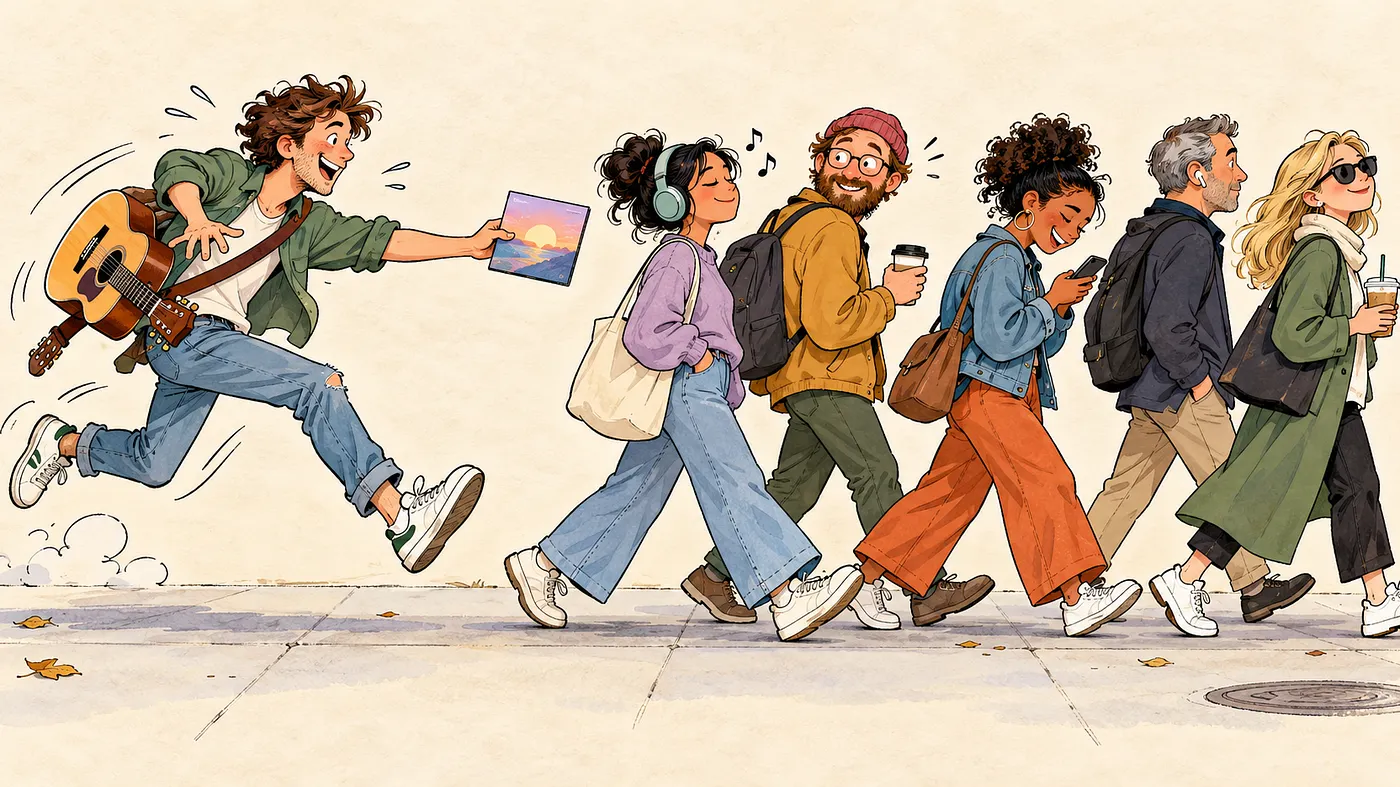
Chasing after fans is an obsession for some artists. Photo Credit by Michael Whalen
Attention loyalty and affection must be voluntary.
Congratulations. Your brand new album is on Spotify (and about 150 other music streaming platforms). Nobody has declared an international holiday, your neighbors remain suspiciously calm, and the world has continued spinning without acknowledging your release date. Even your friends and family are silent like crickets, getting the news of your new release. You spent eighteen months making something that another person can dismiss before the coffee is ready. Your distributor sent a confirmation email. At least somebody followed through…
That sounds vicious. I know. I have spent much of my life composing, recording, producing, and releasing music, and I would love to tell you that the world recognizes all the work involved. Bad news first: it doesn’t. Your recording arrives without an accounting for your sacrifices attached. The listener cannot hear the depleted savings account, all the abandoned versions, or the argument you had with yourself about whether the thing was finished. They hear whatever comes out of the speakers, assuming they press play.
Getting music into the world has become remarkably straightforward. Most distributors operate platforms designed to move enormous numbers of releases through a manageable process. Upload the files, enter the information, supply the artwork, choose a date, and work through the requirements. Problems happen, but the basic service is understandable. You are paying a company to deliver something, and delivery is a problem that technology knows how to solve.
Who is going to care once it gets there is considerably less manageable. There is no box to check for that, although I am sure someone would like to charge us for one. Distribution can make your music available almost everywhere while leaving the question of whether anyone wants it completely unanswered.
Work backward from the moment your album appears. Before the upload came the mastering, the mixing, the performances, the arrangements, and all the decisions that made the recording yours. Somewhere much earlier, there was an idea that interested you enough to pursue. You followed it through uncertainty until it became something another person could hear. That is an accomplishment, even when the release does not produce the response you imagined.
But where, along that path, did another person enter the picture? Did you imagine someone listening, or did you imagine the music being released? Those can feel like the same destination while you are working. Release day has a way of revealing the distance between yourself and the listener.
Availability can look remarkably like arrival. There is your artwork and your name, sitting inside the same application as the artists you have admired your entire life. Everything about the presentation suggests that you have reached the place where music happens. You have reached a place where music can be accessed. What happens next is still an open question.
The standard response is to hand the artist more work. Make videos, post more often, tell your story, and build a community. Be authentic, preferably on a schedule, with appropriate lighting. We have spent years describing the many jobs of the modern musician, as though the right combination of additional responsibilities will eventually remove the uncertainty.
Some of that work is useful. Introducing people to your music matters. So does communicating clearly, following through, and making it easy for an interested person to find you. But no amount of activity creates an enforceable agreement between your effort and someone else’s attention. You can do your job thoughtfully and still hear very little back. You can also spend so much time soliciting a response that you begin to resent the people you hoped would enjoy the music.
Said simply: don’t have any expectations for how your art is received.
Enter the current obsession with “superfans,” the people supposedly waiting to buy every edition, attend every show, subscribe to every offering, and keep the whole enterprise afloat. Apparently, simply having listeners is no longer sufficient. We now need to identify the most devoted ones and develop a business plan around the outer limits of their enthusiasm. Somewhere, a person who loved your last album has been promoted to a revenue strategy without being consulted.
I understand the appeal. A relatively small number of committed supporters can make a substantial difference to an artist’s ability to keep working. But the advice to “build superfans” makes a voluntary human attachment sound like something you can assemble if you follow the instructions. Artists cannot force the creation of listeners, fans, or superfans. We can introduce the work and nurture a relationship when someone welcomes it. We cannot determine how much it will matter to them.
Someone might listen once and move on. Someone else might carry a recording through twenty years of their life without buying a deluxe edition or joining anything. The person spending the most money is not necessarily the person for whom the music means the most. If we measure devotion primarily by what we can sell someone, we risk misunderstanding the connection we claim to value.
There is nothing wrong with offering more to people who want more. The trouble begins when enthusiasm becomes an obligation, or when artists are told that every casual listener represents an unfinished conversion. People are allowed to remain casual listeners. A fan can care deeply and still have a budget, limited time, or no interest in getting closer to the person behind the music. Whatever we offer should leave room for “no, thank you” without making it a failure of loyalty.
Otherwise, pressure begins to creep into an innocent announcement. You start by inviting someone to hear a recording and end up asking them to demonstrate that they support independent artists. Listen, save, follow, share, comment, purchase, subscribe, and please understand how much this means. At some point, the person receiving these requests may reasonably wonder when enjoying music became an unpaid position on your staff.
A fan is allowed to love a song without accepting responsibility for the career of the person who made it. They can buy one album and skip the next three. They can listen privately for years without posting a single word about you. Their affection does not become less legitimate because it fails to produce visible promotional activity. We need to be careful about defining a good listener as someone who performs useful labor.
Artists deserve some freedom here, too. Caring deeply about music does not automatically produce an appetite for managing an audience. A musician might be generous, serious, and devoted to the work while having very little interest in narrating a personal life online. Turning that reluctance into a character flaw is an ugly way to treat someone whose preferred means of expression is already sitting there, waiting to be heard.
And now the specter of AI stands over this entire conversation, offering the prospect of even more music entering a world that has not acquired any additional hours in the day. Making and distributing recordings can become faster. Human attention remains stubbornly human. We still have jobs, children, relationships, worries, and a finite capacity to absorb anything.
The understandable response from musicians is to insist that the human being behind the work matters. I believe that “human made” matters. I also think we should be honest about what we are asking when we make humanity part of the sales pitch. “A person made this” tells a listener something about its origin. It cannot guarantee that the listener will find it interesting, useful, moving, or worth returning to.
Empathy has limits. Someone can care about musicians being treated fairly and have absolutely no desire to listen to my new album. Those positions are perfectly compatible. They can be troubled by artists’ work being used without permission and still turn on music at dinner without wanting to conduct an investigation. People have enough demands on their conscience. Their listening time cannot carry the entire burden of repairing our industry.
Businesses should answer for their decisions about consent, compensation, and the products they distribute. We should not transfer those responsibilities to listeners and ask them to fix everything through sufficiently virtuous consumption. Nor should musicians have to respond by continually displaying how human they are. There is something deeply wearying about spending your life developing a voice and then being told to provide additional proof that a person is attached to it.
Still, caring is real. Anyone who has lived with music knows that a recording can become part of how we remember a person, a place, or an entire period of our lives. Artists can care deeply about the people on the other side of that experience. The trouble comes when we try to manufacture the attachment or turn it into a set of obligations.
Lady Gaga helped establish the Born This Way Foundation with her mother, Cynthia Germanotta, supporting young people’s mental health and building programs around kindness. That is a concrete commitment extending beyond the next release. What interests me is the recognition that the people reached by an artist have lives of their own, with needs that exist independently of whether there is anything new to promote.
Tori Amos has made reading letters from listeners a longstanding practice. She takes in stories from people whose experiences might otherwise never enter her world. There is something instructive about an artist listening to the people who listen to her. It allows the relationship to contain more than the artist’s need to express something.
Geddy Lee and Alex Lifeson offer another perspective through Rush’s 50 year relationship with its audience. Through decades of “meet and greets,” they have acknowledged the loyalty that supported the band, while Lee has spoken about respecting fans’ trust as the music evolved. Rush changed, and some listeners followed while others preferred an earlier version. Respect could coexist with movement. Neither the band nor its audience had to remain frozen in the moment when they first found each other.
These relationships make the language of “building superfans” seem inadequate. A person brings a life to the music, and the artist may never know more than a small part of it. Attachment develops through experiences that cannot be scheduled into a release campaign. The music accompanies someone through something. They return to it. Over time, it becomes theirs in a way the artist could not have planned.
I would be careful about turning any of these artists into a prescription. A foundation, a correspondence practice, and decades of musical trust are different expressions of care. Copying their outward form will not reproduce the relationship underneath. An artist who dreads personal interaction should not be instructed to manufacture intimacy because it appears to work for someone else.
Even the most generous artist has limits. Caring about people does not mean being perpetually accessible to them, and receiving meaningful music does not give a listener ownership of its maker. A relationship needs enough room for both parties to remain people. Otherwise, affection becomes a set of expectations that neither side remembers agreeing to. Expectation leads to resentment.
I understand why this is difficult. When you release something you have lived with for months or years, you want evidence that it landed somewhere. You want to know that the decisions mattered outside your own room. Money may be involved, and the need to earn it is real. Telling a working musician to stop caring about results would be both patronizing and impractical.
The question is how much authority those results acquire over the rest of your life. A quiet release can tell you something about timing, reach, presentation, or the audience you have found so far. It cannot give you a complete verdict on the work, and it certainly cannot give you one on yourself. Yet it is easy to sit in front of a dashboard and allow a handful of numbers to make claims they are incapable of supporting.
There is work we can choose to do. We can introduce a recording thoughtfully, seek out settings where it might make sense, and appreciate the people who respond. We can decide what we can afford, what we are willing to repeat, and what kind of contact we actually enjoy. Those choices give a career some shape without pretending that the right plan will make other people care on command.
We can also leave room for a listener’s experience to be different from our ambition. The piece we hoped would announce a major artistic breakthrough might simply accompany someone’s drive home. That sounds modest until you consider how much of a life happens on the way home. Music can become important without making an announcement about it.
For as many times I have said (and meant) that I make music for myself, I want people to hear what I make. I want the work to travel, and I want to keep earning the opportunity to do it. I also want a creative life that leaves me interested in creating, with listeners who feel welcome rather than responsible. Neither side should have to become an unwilling employee of my ambition.
The distributor can put a recording within reach. I can invite someone to listen. What happens after that belongs partly to a person I may never meet, living a life I know nothing about. If they return to the music, I can be grateful. If they don’t, I can let them go without making either of us the villain. True artists empower a listener’s choice.
So, for all the machinery surrounding music, there is still something extraordinary about that freedom. Someone hears what you made and chooses to spend more of their life with it. They did not owe you that time. They do not have to become a superfan to make it meaningful. The fact that they came willingly is the part worth protecting and cherishing…





Leave a Reply