
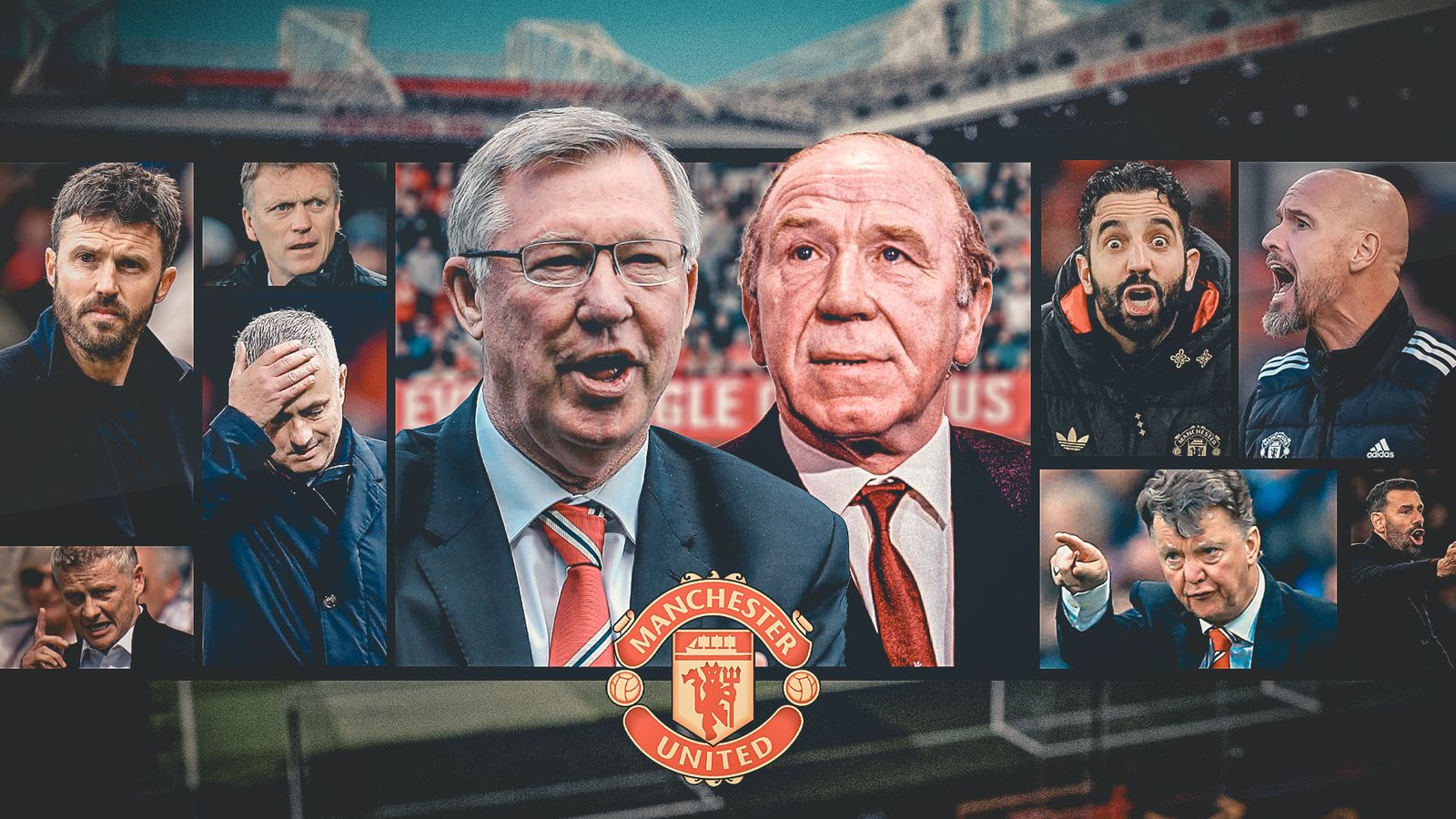
The succession problem
Ferguson knew replacing him would be an enormous challenge.
In Leading, he was candid about the search for his successor.
“At United we didn’t have an obvious internal successor, though it was not for want of trying,” he wrote.
He had encouraged Ryan Giggs, Gary Neville, Darren Fletcher, Nicky Butt, Dwight Yorke and Andy Cole to earn their coaching credentials. But he did not believe a player should move straight from the dressing room into the manager’s office.
“United tried that once when Wilf McGuinness succeeded Matt Busby in 1969,” Ferguson wrote. “It was a disaster.”
He also revealed that he had admired Pep Guardiola and asked him to phone before accepting an offer from another club. Guardiola eventually joined Bayern Munich in July 2013.
Sir Alex Ferguson contacted Pep Guardiola in his search for a successor at Old Trafford
Sir Alex Ferguson contacted Pep Guardiola in his search for a successor at Old Trafford
Other candidates were unavailable. Jose Mourinho had given his word to Roman Abramovich that he would return to Chelsea, Carlo Ancelotti was heading to Real Madrid, Jurgen Klopp was staying at Borussia Dortmund and Louis van Gaal was preparing to lead the Netherlands at the World Cup.
Eventually, United chose David Moyes.
Ferguson defended the appointment in his book, pointing to Moyes’ work at Everton and the financial constraints under which he had operated.
“Sadly, things did not turn out for David as he and we all wished,” he wrote.
He also acknowledged that the transition could have been handled differently, suggesting that keeping Mike Phelan might have helped Moyes navigate the many layers of the club.
But the transition was bigger than the appointment itself. Ferguson retired. Chief executive David Gill left. The manager who had controlled the club for 26 years was gone, alongside a key figure who had helped him run it.
David Gill was Man Utd’s CEO from 2003 before stepping down in 2013
David Gill was Man Utd’s CEO from 2003 before stepping down in 2013
Danny Taylor, who covered United during Ferguson’s reign, remembers just how much of the club’s operation revolved around the manager.
After United won the Champions League in 1999, Ferguson held a press conference for local Manchester beat journalists rather than the wider press. It was a small example of the control he exercised, even over details that might seem relatively minor.
Taylor experienced the more difficult side of that relationship, too. After writing a book covering United’s turbulent 2005-06 season, he was banned from Ferguson’s Friday press conferences from 2007 until the manager retired in 2013.
He had not had an argument with Ferguson.
“He used to always say, ‘I really encourage young people’,” Taylor told me.
“But the journalists, he thought we were all babies, he thought we were all kids.”
Taylor recalled a colleague’s first encounter with Ferguson, after which the manager reportedly remarked that he “looks like the bass player of Oasis”.
It is an amusing recollection, but Taylor’s wider point is more serious. Ferguson was fiercely protective of his territory and maintained a tight grip on the club’s operation.
“You just thought, when he leaves, the club is just very, very ill-equipped at all levels to deal with what’s next,” Taylor said.
The reality is that the authority Busby and Ferguson exercised was part of their success, but it left a vacuum when they went.
Moyes himself later reflected on the difficulty of the job in 2014.
David Moyes inherited the Premier League Champions but failed to drive similar success
David Moyes inherited the Premier League Champions but failed to drive similar success
“I was devastated to lose the job because it was something I felt we could make a real success of,” he said.
“In the end, I don’t feel I was given the time to succeed or fail.”
He also pointed to the fact that both he and former executive vice-chairman Ed Woodward were new to their roles.
“I had taken over from the most successful manager in history,” Moyes said.
“The chief executive had taken over from one of the most renowned administrators in the game. So it was a new job for two people.”
Roy Keane was less sympathetic towards the players who failed to help Moyes.
In The Second Half, Keane questioned the strength of the dressing room and the responsibility of players to support a new manager.
“Not liking a manager, for whatever reason, can never be an excuse for not going out and doing your best,” he wrote.
His conclusion was damning: “Looking at what happened to David Moyes, I have to conclude that he can’t have had a strong dressing room; he had a weak dressing room.”
The failure of the post-Ferguson era cannot be attributed to the manager alone. The players, the owners, the board and the wider structure all had a role in what followed.
Moyes was the first, but certainly not the last.
Louis van Gaal was sacked despite delivering an FA Cup in his final act in charge at Man Utd
Louis van Gaal was sacked despite delivering an FA Cup in his final act in charge at Man Utd
Ryan Giggs took charge on an interim basis after Moyes’ dismissal, before Louis van Gaal arrived in 2014.
The Dutchman brought a clear yet alien philosophy and delivered the FA Cup, but could not restore United to the top of the league.
Jose Mourinho followed, winning the League Cup and Europa League and finishing second in the Premier League.
Jose Mourinho won the Europa League and League Cup during a two-and-a-half-year spell in Manchester
Jose Mourinho won the Europa League and League Cup during a two-and-a-half-year spell in Manchester
Arguably he was the closest of Ferguson’s successors to delivering a sustained challenge, but the relationship between manager, players and club eventually deteriorated.
Ole Gunnar Solskjaer, initially appointed as caretaker before getting the job permanently, brought a sense of connection with supporters and came closest to creating a team that felt familiar.
Ole Gunnar Solskjaer was appointed permanent boss after promising spell as interim
Ole Gunnar Solskjaer was appointed permanent boss after promising spell as interim
He finished second in the league, reached a Europa League final and restored some optimism around Old Trafford, but could not deliver silverware.
Michael Carrick briefly took charge as caretaker after Solskjaer’s departure, before Ralf Rangnick arrived as interim manager.
Rangnick’s six months were turbulent, but his assessment of the club has since proved difficult to ignore.
Ralf Rangnick followed on from Solskjaer and a brief interim stint from Michael Carrick
Ralf Rangnick followed on from Solskjaer and a brief interim stint from Michael Carrick
He’s famed for suggesting “surgery at the open heart” in relation to improving the playing squad. However, speaking to SPORT in 2025, Rangnick traced United’s problems back to Ferguson’s departure.
“At the time he was still there, he was the mastermind behind it all,” he said.
“The moment he left, some of those people probably left the club as well. And, since then, I think they have a leadership problem.”
Rangnick said it was difficult even for him, as head coach, to understand who was making the important decisions.
“Who’s really making the decisions and why are they making them? Are they really the best people for the job? I can only tell you that the six months I was there, it was difficult to say, even for me as head coach.”
Erik ten Hag won a League Cup and FA Cup while at the wheel
Erik ten Hag won a League Cup and FA Cup while at the wheel
Erik ten Hag took charge in 2022 and won the League Cup before adding the FA Cup in 2024. But his tenure was increasingly defined by inconsistency, difficult relationships and questions over recruitment.
He has since offered his own account of the breakdown with the club. In an interview with The Athletic in October 2026, Ten Hag claimed that INEOS made a series of promises after talks in Ibiza following the FA Cup final.
“They promised me loyalty, they promised me backing, they promised communication, that we get aligned,” he said. “But the promises, they didn’t keep.”
Ruud van Nistelrooy then took charge on an interim basis following Ten Hag’s dismissal, before Ruben Amorim was appointed. Darren Fletcher also stepped in as caretaker during the latest change in the dugout, before Michael Carrick returned.
The managers and their footballing philosophies have varied enormously, but United have still not found a settled direction.
Ruben Amorim was aware of the weight of that comparison before he had even officially taken the United job.
Ruben Amorim lasted just 14 months at Old Trafford
Ruben Amorim lasted just 14 months at Old Trafford
Ahead of his final Champions League match with Sporting against Manchester City, he was asked about the expectations his arrival might create.
“If we win tomorrow, people will think that the new Alex Ferguson has arrived, and of course, it will be difficult to live up to that expectation,” Amorim said.
Sporting won that game 4-1. The result only sharpened the anticipation around his appointment, but Amorim’s warning was telling: the Ferguson comparison was already waiting for him before he had taken charge of a training session.

Leave a Reply