
This article contains light spoilers for “Godzilla Minus Zero.”
Godzilla has enjoyed a lasting popularity over his 70+ year existence, and it’s no surprise. Ishirō Honda’s 1954 “Godzilla” not only had a great title creature, but also involved a surprisingly weighty human drama that combined a love triangle with huge ethical conundrums, all of which fed into the film’s impressively deep thematic material. It’s a killer mixture, and Honda’s movie is still thought of as one of the best movies ever made in the franchise all these years later. Although Toho Studios didn’t immediately push the series towards bigger spectacle, the “Godzilla” films naturally took that course. Each successive film began creating bigger monster attack setpieces, and generated greater destruction by pitting the various monsters against each other.
This direction left any human characters with less screen time and importance in each movie. As such, the various writers and directors began to treat them more as perfunctory protagonists. While there have been several attempts to course correct this, it’s a problem that persists. Even the MonsterVerse films have fallen prey to the common criticism that the human characters are second-rate.
This is part of why Takashi Yamazaki’s “Godzilla Minus One” felt like such a breath of fresh air. That movie features a human story that is undeniably the core of the film, with Godzilla being more of a supporting feature. That approach continues in the sequel, “Godzilla Minus Zero,” which doubles down on the great character work “Minus One” did by continuing the stories of already established characters, while also adding a few great new ones.
Godzilla Minus Zero doesn’t go through dramatic motions waiting for the monsters
To be fair, there have been many prior movies in the “Godziilla” franchise that have featured some really compelling human characters and storylines to go with them. A few which leap to mind are “Godzilla vs. Biollante,” “Godzilla vs. Destoroyah,” and “Shin Godzilla.” What these movies do well is find characters and a story that isn’t completely based around attacks by Godzilla or other giant monsters, meaning that the characters are as proactive as they are reactive. When the latter becomes their primary function, the movies themselves essentially train the audience to not care about the humans as much, teaching them to wait patiently until the next big action scene occurs. In this way, the issues that some “Godzilla” movies have aren’t all that different from a similar problem many genre movies face.
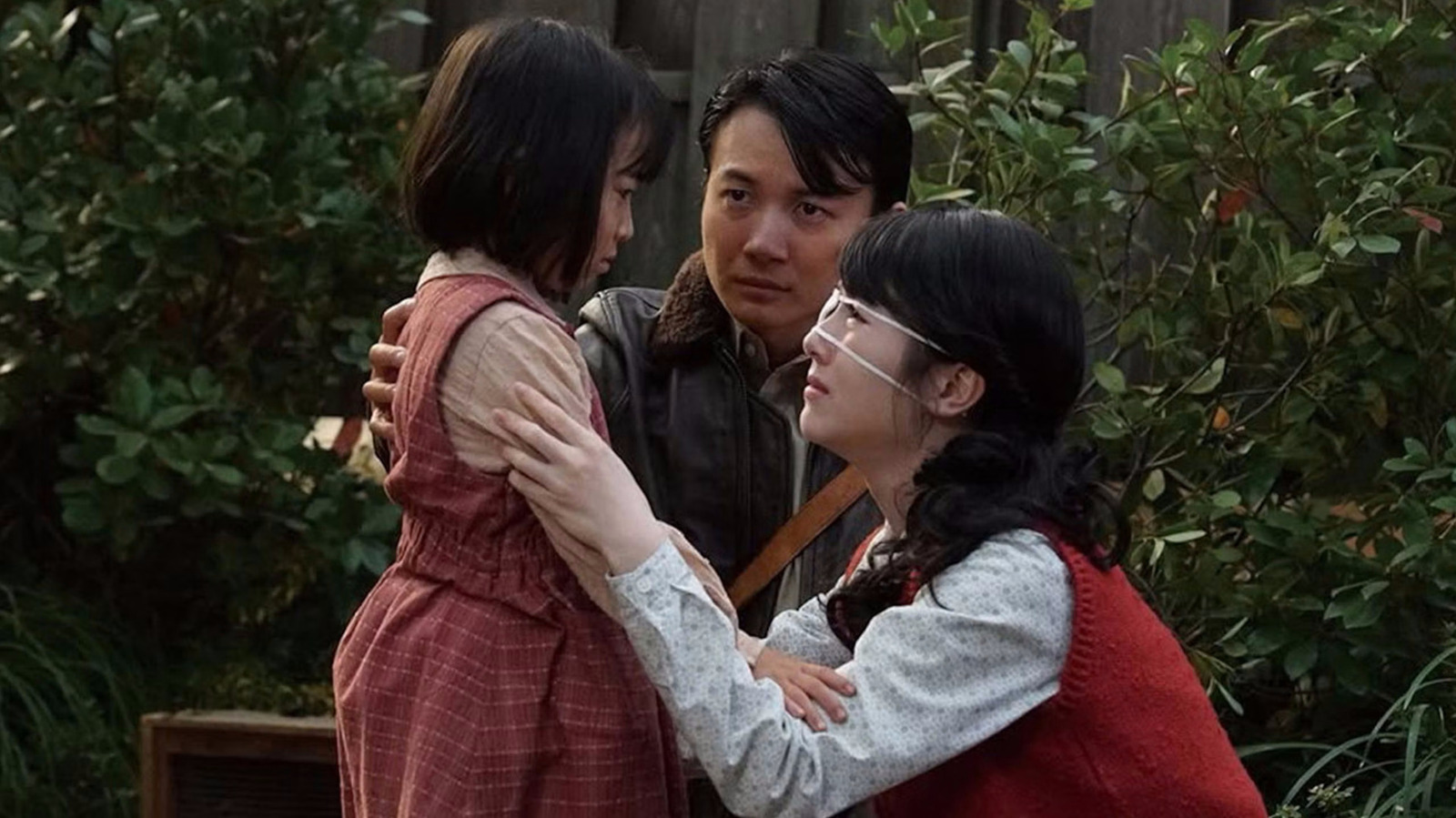
Where Takashi Yamazaki transcends this issue in “Godzilla Minus Zero” is in the way that he creates dramatic tension between the characters and Godzilla (or, in the film’s case, Ghidorah) appearing. We the audience wish to see the giant monsters we came for, but Yamazaki’s story positions many of these people as those who would likely be worse off should they turn up. Scientist Kenji Noda (Hidetaka Yoshioka) is barely keeping a still-hurting Japan’s head above water post World War II, let alone having to deal with kaiju attacks. The continued existence of Ghidorah is a personal burden to meterologist Makoto Aoyama (Masami Nagasawa), while Godzilla’s abilities present a dark temptation to professor Kanji Murakami (Min Tanaka). Meanwhile, Kōichi Shikishima (Ryunosuke Kamiki), who found his will to live in “Minus One,” is struggling like mad to keep his family together. Yet in addition to caring for adopted daughter Akiko (Saw Nagatani), his wife Noriko (Minami Hamabe) has been infected with Godzillas cells, which may end up killing her or could be used in other ways. The tension between wanting to see Godzilla and not wanting these people to suffer as a result is what Yamazaki exploits so beautifully.
The focus on characters makes Godzilla Minus Zero moving and memorable
One of the most impressive aspects of “Godzilla Minus Zero” is its restraint. As a big-budget direct sequel to the very successful “Godzilla Minus One,” it would’ve made sense for Takashi Yamazaki and his crew to go bigger with the film’s visual effects. The temptation to do this must’ve been especially great considering that “Minus One” won the Academy Award for Best Visual Effects, making it the first “Godzilla” film ever to win an Oscar. Given that triumph, it’s actually rather remarkable that Yamazaki didn’t turn “Minus Zero” into a VFX extravaganza.
Instead, Yamazaki appears to deeply understand what makes visual effects great, which is their ability to enhance an already good story and its characters. The action sequences in “Minus Zero” are memorable because of how uniquely designed they are and how they utilize the characters. Moments like Shikishima flying through a village that’s been upended by Ghidorah’s gravity beam and Noda having to race against time to spring a trap on Ghidorah are made better because of the characters being directly involved in the action, not just observing.
All of this is why the big climax of “Godzilla Minus Zero” has relatively little to do with Godzilla and Ghidorah and is mostly to do with the fates of the human characters themselves. In a lesser movie, such scenes would feel like an obligatory denouement. in “Minus Zero,” they’re as riveting as anything else in the film. It may have taken over 70 years, but “Godzilla” has indeed finally circled back to where it began: a human drama that happens to feature a giant monster (charismatic as he may be).
“Godzilla Minus Zero” is in theaters now.






Leave a Reply