
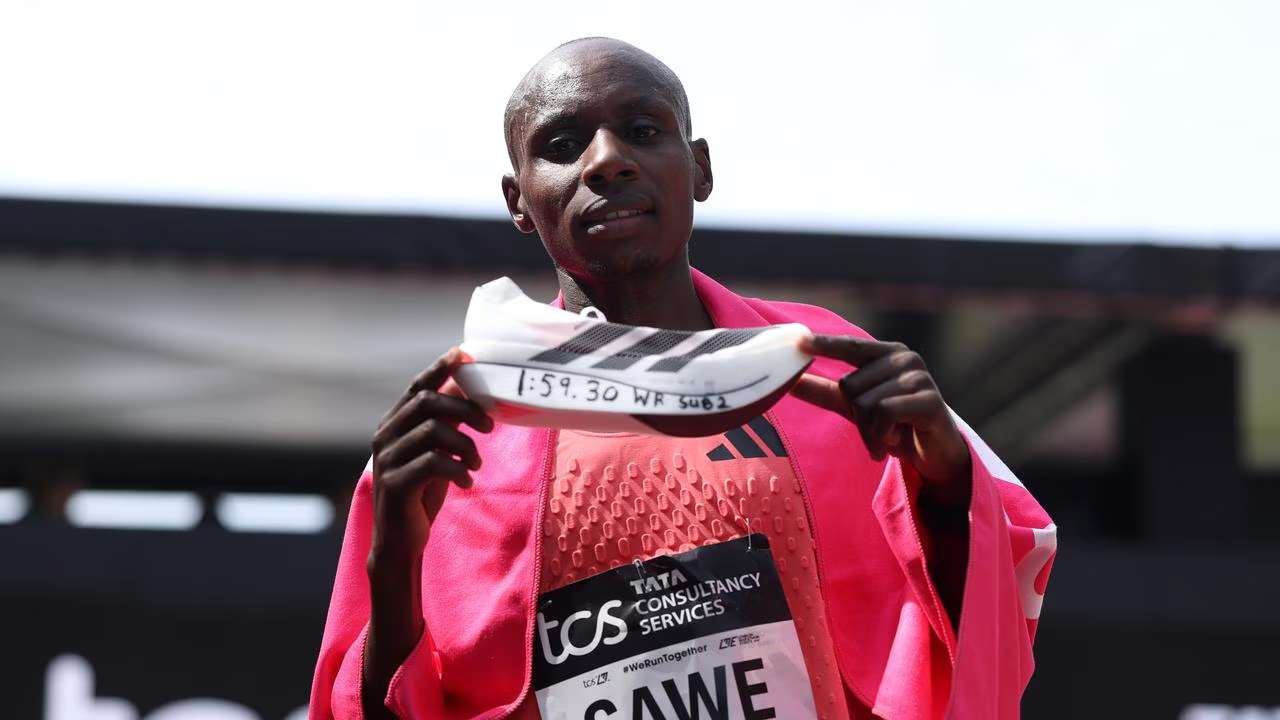
Off the back of a modern day space race between two of the world’s biggest brands and a crusade to remove an unwanted stigma from his sport, Sabastian Sawe produced one of the greatest sporting feat’s in human history on Sunday.
The Kenyan runner shattered the marathon’s glass ceiling, crossing the finish line in London in a world record time of one hour, 59 minutes and 30 seconds.
Watch the biggest Aussie sports & the best from overseas LIVE on Kayo Sports | New to Kayo? Join now and get your first month for just $1.

Many in the world of athletics thought a sub two-hour marathon was impossible.
But Sawe was not the only one to break new ground.
Ethiopia’s Yomif Kejelcha clocked the fastest marathon debut ever with a time of 1:59:41.
While Uganda’s Jacob Kiplimo (2:00:28) also bettered the previous world record of 2:00:35 – set in Chicago in 2023 by the late Kelvin Kiptum, who tragically died in a car crash in 2024.
The times were mind-blowing as the world’s best marathon runners crossed the finish line on The Mall, in front of Buckingham Palace.
For many in the industry, however, it was the day that had been dreaming of for many years.
They have been testing the limits of what a human can achieve in the marathon for decades, and one side picked up a major victory courtesy of Sawe’s excellence.
While the other side admitted their rivals won the battle, but the war will rage on.
ADIDAS v NIKE
The world’s two biggest sporting brands have been at the forefront of the marathon’s latest innovation.
Just as the United States and the Soviet Union raced one another to put a man on the moon, Adidas and Nike have gone head-to-head to propel a man to run a sub two-hour marathon.
Nike did so first.
Kenya’s Eliud Kipchoge became the first person to accomplish the feat back in 2019.
But it did not count as a world record.
Kipchoge’s run in Vienna featured rotating pacemakers, hydration being delivered to the runner on bicycles and no open competition.
So, the record did not stand.
But Nike spent millions on getting Kipchoge to break that barrier, and he did so in the Nike ZoomX Vaporfly 4% super shoes – which claim to improve running economy by four per cent.
That came after a failed attempted two years prior in a previous version of the footwear.
Adidas were slower to get there, but did so for real.
Sawe donned Adidas’s new Pro Evo 3 super shoe for his historic run.
So too did Kejelcha.
Adidas will be licking their lips as the shoes become available to the public later this month for US$500 ($698) a pair after Sawe held the shoe up the cameras after inscribing ‘1:59:30’ on the sole.
Although, they are no designed for consistently pounding the pavement.
Instead, the shoes were made with a one-race philosophy, prioritising peak performance over durability with its super fast foam and carbon plate.
They are the first of their kind to weigh less than 100 grams and that figure was the other mark shoe brands have been trying to break.
It is roughly half the weight of the previous version.
Adidas and Nike as well as the likes of Asics and On are trying to get their running shoes to as near weightless as possible.
Their next goal is to reduce the weight to roughly 50 grams – about the same as socks.
“When you give them the box, they think it’s a joke,” Patrick Nava, general manager of Adidas running, said.
“They think the box is empty.”
For now, Nike opted to be gracious in defeat.
They posted on their social media channels a quote from Kipchoge, saying “we are just at the beginning of what is possible when talent, progress, and unwavering belief in the human potential come together”.
Nike accompanied it by saying “well done” to Sawe and including another message of “the clock has been reset. There is no finish line”.
They feel like fighting words as Nike feels the effects.
The brand is experiencing a significant downturn with its stock trading at trading at US$44.69 on Monday morning, after peaking five years ago at $165.
Last year, Nike’s revenue dropped to US$65 billion from US$72b in 2024.
But while this shoe battle is at the heart of the sport’s future, it is only part of the story.
ANTI-DOPING CRUSADE
The marathon has been tarnished by doping offences in recent years.
Sadly, but sometimes understandably, questions are raised whenever any records are broken.
But Sawe has endeavoured to ensure that is not the case.
Sawe’s home country of Kenya currently has more than 140 athletes suspended by the Athletics Integrity Unit (AIU) as a result of doping.
It is a problem that enrages in the 29-year-old.
When his countrywoman Ruth Chepngetich was banned last July for testing positive to banned diuretic HCTZ, five months after breaking the women’s marathon world record in Chicago, Sawe drew a line in the sand.
Chepngetich’s ban came two months before Sawe attempted to break the world record at last year’s Berlin marathon.
So, he wanted to make sure that were would be no question marks hanging over his head if he got there.
“I wanted to prove to the world that we Kenyans can achieve amazing results without there always (being) the dark cloud of doping over our heads,” Sawe wrote in an email to LetsRun.com.
“I wanted people to know that whatever happened in the race, I was not to be doubted.”
Sawe fell short of the world record, but won by almost four minutes with a time of 2:02:16 on an unseasonably hot September day.
His victory in Berlin came after he was drug tested 25 times in the lead-up.
He was made to give a mixture of urine and blood samples.
The testers came knocking early in the morning and late at night.
Sometimes they came twice a day.
And Adidas paid for most of it.
A single drug test can cost more than US$2,000 and in 2024 the AIU spent US$4.5m on testing – 37 per cent of its entire budget.
So, the brand contributed US$50,000 to cover the cost of Sawe’s pre-Berlin testing regime.
Adidas are eager to protect their own reputation.
It would be their super shoe, not drugs, giving their athlete the edge.
And that is why they will continue to contribute US$50,000 to testing Sawe every year for the entirety of his contract.
While Sawe, who is set to earn more than a US$1m in bonuses from Adidas, and members of his team felt strongly about protecting his own legacy.
Sawe’s coach Claudio Berardelli had his reputation impacted by several of his former athletes being hit be doping bans, including three-time Boston Marathon champion Rita Jeptoo and 2023 Hamburg Marathon champion Dorcas Tuitoek.
“(Sabastian) was adamant that he needed to take a stance and send a strong message to other athletes and the sport in general,” Sawe’s agent Eric Lilot said.
“That message was that incredible talents do truly exist and that fantastic performances are indeed possible, without illicit means.”
Sawe’s feat was not just built off his amazing talent either.
He has most certainly put in the work.
“In the last six weeks he was averaging 200km and above a week, while the peak was 241km,” Berardelli said.
“I knew he was super-good for Berlin, but he couldn’t express himself because of the conditions.
“But when I started to see him running the way he ran before London, I was like, hey, something special might come out.”
WHERE IT STANDS IN HISTORY
Something special did indeed come out with journalists, past athletes and fans alike quick to place it among sport’s greatest ever achievements.
Breaking two hours for a marathon was something that almost no one thought was possible.
Australia’s Derek Clayton, whose 1969 record of 2:08:33 stood for 12 years, famously scoffed at the notion.
“A two-hour marathon? 4:34 mile pace? Definitely not,” Clayton said.
The Telegraph’s chief sports writer Oliver Brown put Sawe’s run through central London in laymen’s terms.
“Yes, you can credit his quantum leap to his feathery wisp of a super-shoe, but there is no footwear on earth capable of delivering this result without supreme speed endurance from the athlete wearing it,” Brown wrote.
“To put it into context, the Kenyan’s average pace was a shade over 13mph, a level that most gym treadmills do not even possess. Most casual runners would struggle to last 30 seconds at such a setting, never mind a couple of hours.
“Sawe recorded negative splits, tearing through the second half of the marathon in 59 minutes. Maybe you could imagine running 100 metres in 17 seconds. But could you comprehend doing it 422 times in a row?”
The Telegraph have ranked Sawe’s record as the sixth best sporting achievement of all time.
Only Nadia Comaneci’s perfect ten on the uneven bars at the 1976 Montreal Olympics, Roger Bannister becoming the first man to run a sub four-minute mile in 1954, Muhammad Ali’s ‘Rumble in the Jungle’ victory against George Foreman, Usain Bolt’s 100m world record at the 2009 World Championships and Tiger Woods’ 15-shot victory in the 2000 US Open – which was awarded top spot – stood above Sawe in the British newspaper’s rankings.
There have been parallels drawn to Bannister’s efforts 72 years ago.
London Marathon race director Hugh Brasher’s father Chris paced Bannister to his famous sub-four minute mile, and he said that Sawe’s time of 1:59:30 deserved to be viewed in the same light.
“The sub-four mile was in Britain,” Brasher said. “Sub two hours for the marathon was in Britain. These are historic feats. People said that Sir Roger Bannister’s mile was the greatest sporting moment of the 20th century. Is this the greatest sporting moment of the 21st century? I don’t know, but it was just brilliant.”
Brasher also labelled it “without doubt, the greatest day in London Marathon history”.
While Sawe’s coach Claudio Berardelli hailed his athlete as a “special one”.
“There is no doubt we are in the new era of marathon running because of the shoe and proper fuelling,” he said.
“So we are super-glad to Adidas and Maurten. They have come to Kenya so many times to support us, because all of us realise that Sabastian was not just a good one, but he’s a special one.
“Definitely physiologically, Sabastian has to be a good one. But all the pieces come together perfectly, because of his attitude, because of his character. I’m still in the process of discovering who Sawe is. He is an exceptional human being. He has such a positive energy, but he’s so humble at the same time.
“In 22 years I’ve been coaching in Kenya I thought I’d seen pretty much everything, but then Sabastian started to show me something which I thought was almost impossible.”
How Sawe’s accomplishment sits in the pantheon of sporting achievements will become clearer over time.
Some in the sport, believe it might be the dawn of a new era.
Renowned running coach Steve Magness took to social media to reflect on how far things have come in such a short time, and the new wave of belief that has swept through the world’s best runner.
“Even with the shoes and tech, a few years ago sub 2 hours seemed a long way off, until Kipchoge pushed that barrier in a series of time trials,” Magness wrote.
“Yes, they weren’t official races and had contrived pacing. But it absolutely shifted everyone’s thinking on what is possible.
“A generation of runners saw Kipchoge go for it.
“Our prediction of what is possible changed.
“It’s mind blowing how far we’ve come in such a short time.
“What once seemed decades away, just got smashed twice in the same race.
“Hats off to Sawe, especially for addressing the scourge of doping and showing folks what is possible with a lot of hard work, some crazy belief, and some fortuitous advances.”
Berardelli believes Sawe may not be done there.
Even though the London circuit is famously quite flat, leading to better times, he believes Sawe could run even faster in famously quicker layouts like Berlin and Chicago.
“I would say yes, it is possible,” Berardelli said.
“Sabastian hasn’t reached his maximum potential. It was only his fourth marathon, if we think of long-term adaptations, which is a process requiring time, I believe Sabastian has not reached this yet.”





Leave a Reply