
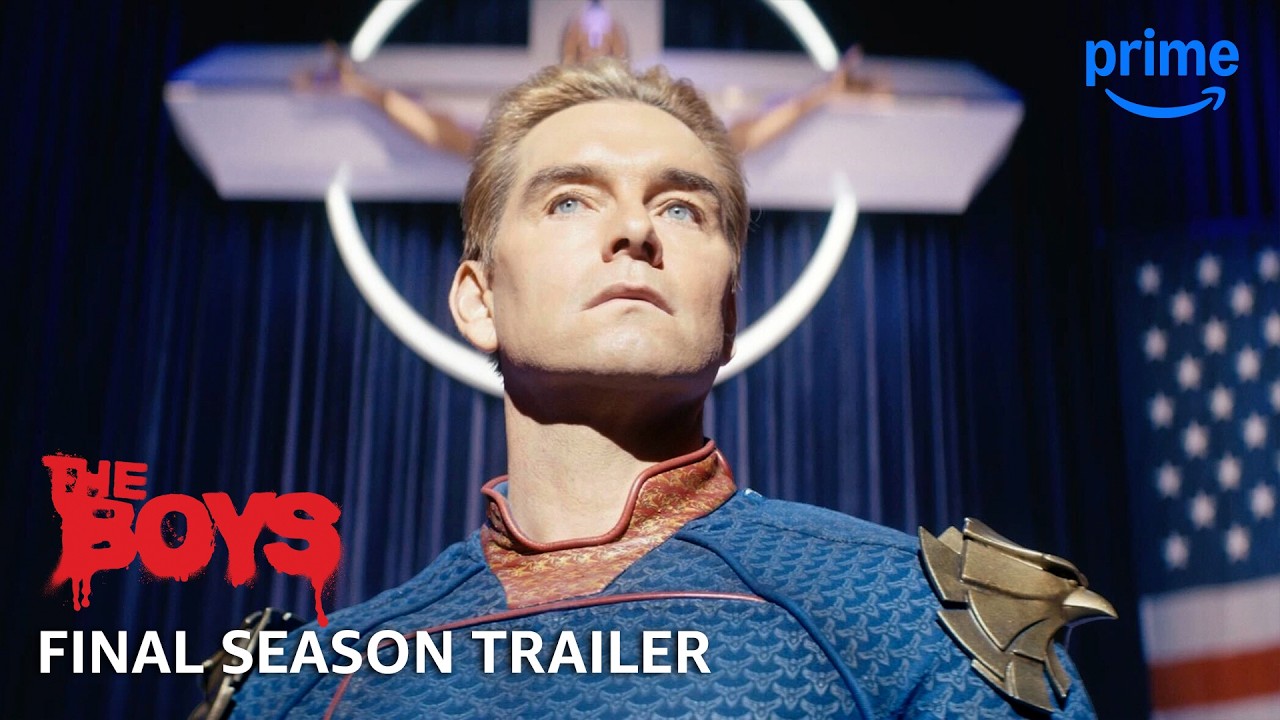
The Final Season of the Most Politically Prescient Show on Television — Homelander Has Won, America Has Fallen, and The Boys Have Never Been More Outmatched
Homelander has achieved total power. Vought produces anti-immigrant agitprop penned by a Taylor Sheridan AI. The Boys — Butcher, Hughie, MM, Frenchie, Kimiko — are detained in a Vought facility or in hiding. Annie/Starlight is the resistance’s Emmanuel Goldstein to Homelander’s all-American Big Brother. Daveed Diggs joins the final season as Oh-Father, a superpowered man of the cloth married to the new Vice President. Gen V characters — Jordan Li, Marie Moreau, Emma Meyer — enter the main universe. Created by Eric Kripke, based on the Garth Ennis-Darick Robertson comic series. Produced by Sony Pictures Television and Amazon MGM Studios. World premiere Cinema Moderno, Rome, March 19, 2026. Prime Video premiere April 8, 2026, two episodes. Remaining eight episodes weekly, season finale May 20, 2026. 4 Primetime Emmy wins. 26 wins and 97 nominations total across five seasons. IMDb 8.6 from 860,900 viewers.
Why It Is Trending: 96% Rotten Tomatoes — The Show That Predicted Trump’s Second Term Is Ending in the Middle of It — Kripke’s “Blow the Doors Off” Final Season Promise Delivered
The Rotten Tomatoes consensus: “The Boys stays true to its form and completes its mission with ample panache, narrative pay-off, and an excess of blood and guts to deviously glorious effect.” Variety’s most precise positioning: “If you thought The Boys was dark before, just remember that the penultimate season aired prior to the reelection of President Donald J. Trump — The Boys is ending right on time.” Roger Ebert’s site: “The invisible veil between our television screens and the world we inhabit grows thinner with each episode.”
Elements Driving the Trend: Homelander’s Calculated Confidence, Kimiko’s Voice, and the Detention Camp America
-
Homelander is “no longer defined by instability or impulsive violence — he operates with a calculated confidence that makes him far more dangerous,” giving Antony Starr his most formally terrifying performance register of the series.
-
Kimiko finally gets a voice this season — and the comedy of hearing what she says is immediately among the season’s most praised character moments.
-
The Freedom Camps — detention facilities for political dissidents — are the season’s most direct and most uncomfortable political mirror, arriving as the most unsubtle version of the show’s satirical argument.
-
Daveed Diggs’s Oh-Father — revealed at Rome world premiere — gives the season a villain whose religious and political power combination is the most formally specific new satirical target.
Virality: The Rome World Premiere and the “Ending Right on Time” Critical Consensus
-
The world premiere at Cinema Moderno, Rome, is the most unusual single staging decision in the show’s history — the European political context giving the fascism satire its most formally specific premiere geography.
-
The critical consensus that The Boys is “ending right on time” — the show’s satirical targets having been fully realised in the real world during production — is the season’s most commercially powerful and most culturally resonant single discovery framing.
Critics Reception: Near-Unanimous Acclaim — the Grimness the Only Divided Quality
-
Roger Ebert: “doubles down on its brashness — the most uninhibited version of itself, spewing profanity, vitriol and bodily fluids with abandon; rather than overstay its welcome, the show has wisely opted to go out with a bang.”
-
Variety: “heavy, blood-soaked finale — in its final hours, free to be the most uninhibited version of itself; major character deaths very much on the table.”
-
Cosmic Circus mid-season: “what really defines the final season is how heavy and serious everything feels — consequences are immediate, no breathing room between mistakes.”
-
Consequence (dissent): “the gruesome yet hilarious violence just seems less funny this go-around — the show has finally run up against the limit of how many times we can watch a person get ripped apart and still find it entertaining.”
-
Rotten Tomatoes 96%. IMDb 8.6 from 860,900 viewers across five seasons. 4 Primetime Emmy wins.
Awards and Recognitions: 4 Primetime Emmy Wins — 26 Wins and 97 Nominations Across Five Seasons
-
4 Primetime Emmy wins. 26 wins and 97 nominations total. IMDb Top Rated TV #137.
-
World premiere Rome March 19, 2026. Prime Video April 8, 2026. Season finale May 20, 2026.
Creator and Cast: The Showrunner Who Promised to Blow the Doors Off — and the Actor Who Spent Seven Years Making Homelander One of Television’s Most Terrifying Performances
-
Eric Kripke — Supernatural, The Boys — delivers the final season he promised at Comic-Con: “super big, apocalyptic — you can blow the doors off it, there’s no guarantee who’s going to survive because you don’t have to keep the cast for another season.”
-
Antony Starr (Homelander) — the performance consensus across all five seasons; the calculated confidence of Season 5 Homelander is described as his most formally terrifying register.
-
Karl Urban (Butcher), Jack Quaid (Hughie), Erin Moriarty (Annie/Starlight) — the three-character emotional core whose final arcs define the season’s most personally invested sequences.
-
Daveed Diggs (Oh-Father) — the season’s most significant new addition; his religious-political power combination the most formally specific new satirical target.
-
Karen Fukuhara (Kimiko) — whose first spoken lines generate the season’s most immediately celebrated character moment.
Conclusion: The Most Politically Prescient Final Season in Recent Television History — Arriving at the Precise Cultural Moment When Its Satirical Targets Are Fully Realised in the Real World
The 96% Rotten Tomatoes score, the Rome world premiere, and the critical consensus that The Boys is “ending right on time” collectively confirm a final season that has transcended genre entertainment to become a cultural document. Homelander’s Freedom Camps and Starr’s calculated confidence are the season’s two most indelible formal contributions to seven years of the most politically specific superhero satire in television history.
What Trend Is Followed: The Superhero Satire Reaches Its Logical Endpoint — When the Fictional Fascist’s America Becomes Indistinguishable From the Real One
Variety’s most precise formulation: “The world has caught up with the show’s bleakly funny vision of an unholy alliance among big business, cultural conservatism, and soulless entertainment.” The Boys belongs to the political satire tradition — Dr. Strangelove, Network, Veep — in which the satirical target’s real-world acceleration eventually overtakes the fiction’s ability to stay ahead of it. Season 5 is where that overtaking is complete — and where the show’s formal response is to stop satirising and start documenting.
Trend Drivers: The Show’s Satirical Targets Made Real, the Final Season’s Tonal Shift From Dark Comedy to Political Horror, and the Freedom Camps
-
The show’s most formally significant Season 5 departure: the satirical distance between the fiction and reality has collapsed — Homelander’s detention camps, his AI propaganda, his Vice President installation are not exaggerations of current events but descriptions of them.
-
The tonal shift from dark comedy to political horror is the season’s most divisive formal decision — the violence that was funny in earlier seasons is “less funny this go-around” because the political context it satirises is no longer hypothetical.
-
The Freedom Camps — “ESCAPE ATTEMPTS WILL BE MET WITH DEADLY FORCE. Have a super day!” — are the season’s most formally precise satirical invention and its most uncomfortable single element.
-
Vought producing “anti-immigrant agitprop penned by a Taylor Sheridan AI” is the season’s most specifically targeted cultural satire — naming the specific intersection of streaming platform content and political propaganda.
What Is Influencing Trend: The Trump Second Term as the Show’s Most Consequential Real-World Event — and Prime Video’s Most Commercially Motivated Final Season
-
Variety: “The penultimate season aired prior to the reelection of President Donald J. Trump — that chapter concluded with Homelander assuming control of the United States itself.”
-
The show’s seven-year run has coincided precisely with the political period it satirised — Season 1 (2019) arriving at the start of Trump’s first term, Season 5 (2026) arriving during his second — giving the series a biographical relationship to its political context that no scripted show has previously achieved at this scale.
-
Prime Video’s investment in the franchise — Gen V, the forthcoming Vought Rising prequel — gives the final season its most commercially motivated institutional context: a conclusion designed to validate the entire universe’s expansion rather than simply close a story.
Macro Trends Influencing: Superhero Fatigue’s Selective Exemption and the Political Satire’s Streaming Moment
-
The Boys has consistently been exempted from the superhero fatigue that has diminished the MCU’s theatrical performance — its anti-superhero register positions it within political drama rather than genre entertainment for its core audience.
-
The political satire’s streaming moment — enabled by Prime Video’s content freedom that network and even cable television cannot match — gives Kripke the formal latitude to show what fascism actually looks like without the moderation that conventional broadcast requires.
-
The Gen V integration — Jordan Li, Marie Moreau, and Emma Meyer entering the main universe — gives the final season its most commercially expansive audience reach across both series’ fanbases simultaneously.
Consumer Trends Influencing: Seven Years of Audience Investment and the Weekly Release Format’s Sustained Cultural Conversation
-
The show’s 860,900 IMDb voter base — one of the largest active engagement communities in streaming television — gives each weekly episode a sustained critical discourse that a full-season dump cannot generate.
-
The weekly release format sustains the cultural conversation across seven weeks — each episode’s political references generating a news cycle of their own that extends the show’s cultural reach beyond its direct viewership.
-
The Vought marketing universe — the fake ads, the social media accounts, the in-world propaganda — gives the season its most formally distinctive paratext and its most actively engaged community extension.
Audience Analysis: The Show’s Seven-Year Core Following, the Political Satire Audience, and the Superhero-Fatigue Refugee Community
The core audience is 22–50 — the seven-year Prime Video subscriber base that has followed the series across every season, the political satire audience that uses The Boys as a weekly cultural barometer for the Trump era, and the superhero-fatigue refugee community for whom the anti-superhero register has always been the primary discovery argument. The weekly format and the real-world political resonance give each episode a cultural conversation half-life that extends well beyond the individual viewing.
Conclusion: The Final Season of a Show That Spent Seven Years Predicting a Political Reality It Is Now Documenting — Confirming That The Boys Is the Most Formally Urgent Political Satire in the History of Streaming Television
The Boys Season 5 confirms that the show’s most significant formal achievement is not any individual season but the seven-year arc that placed its satirical targets — corporate fascism, superpowered authoritarianism, the weaponisation of entertainment — in a direct relationship with the real-world political events that unfolded simultaneously with its production.
Final Verdict: The Most Formally Urgent Final Season in Streaming Television — A Show That Earned the Right to End Without Optimism and Chose to Use That Right Completely
Kripke delivers exactly what he promised at Comic-Con — apocalyptic, door-blowing, no-guarantees final season television that is the most uninhibited version of the show’s seven-year formal identity. The grimness is intentional and earned. The violence is less funny because the political reality it mirrors is less funny. The Freedom Camps are not a metaphor. The show has always been willing to alienate its audience to maintain its authenticity — Season 5 makes that trade more directly than any previous season.
Audience Relevance: For the Show’s Established Audience Who Followed It Through Four Seasons of Escalating Darkness — Not for New Viewers and Not for Those Who Needed the Comedy to Balance the Horror
Works best for the seven-year audience whose investment in the characters gives the major deaths their full emotional weight — and whose political awareness gives the satirical targets their most immediate personal resonance. The grimness that Consequence found “less fun” is precisely what Roger Ebert and Variety recognised as the season’s most formally honest quality.
What Is the Message: Power Corrupts Without Exception — No One Complicit Deserves Pity, and Resistance Matters Even When It Fails
Consequence’s most precise formulation: “In a world where power corrupts, no one complicit deserves pity — it’s certainly unsubtle, but The Boys has grown up fully as a reaction to these unsubtle times.” The season’s most specific moral argument is that resistance is not about winning — it is about refusing to comply with a system that has already won.
Relevance to Audience: The Only Show That Has Spent Seven Years Naming What Is Happening in Real Time — and That Is Ending While It Is Still Happening
Variety: “The Boys is ending right on time — not only has the world caught up with the show’s bleakly funny vision of an unholy alliance among big business, cultural conservatism, and soulless entertainment, The Boys has also spent its last couple of seasons running out of ways to stay ahead of reality.” The show’s most commercially significant quality in its final season is that it no longer needs to exaggerate.
Social Relevance: Freedom Camps, AI Propaganda, and the Vice President Installed by a Superpowered Fascist — the Season’s Political Specificity Is Its Most Uncomfortable Formal Achievement
The season’s most formally direct social observation — Vought’s Taylor Sheridan AI producing anti-immigrant content, Freedom Camps for political dissidents, a religious superpowered figure married to the Vice President — constitutes the most politically specific satire that a major streaming platform has produced in the post-2024 election period.
Performance: Starr’s Calculated Homelander Is the Season’s Most Formally Terrifying Performance — Fukuhara’s First Spoken Lines Are Its Most Celebrated Character Moment
Starr’s Homelander — no longer impulsive but methodical, no longer seeking approval but enforcing compliance — is the most formally precise expression of the character’s seven-year arc. Every scene he shares with another living person carries the specific tension of not knowing who will survive it. Fukuhara’s Kimiko, finally speaking, delivers the season’s most immediately celebrated character breakthrough — the comedy of her unfiltered voice against five seasons of sign language is the most formally unexpected tonal release in the finale run.
Legacy: The Show That Spent Seven Years Making the Same Argument — and Was Vindicated by Every Year It Continued
The Boys will be remembered as the streaming series that most accurately and most consistently documented the political reality of its production period — and as the show that understood the superhero genre’s ideological infrastructure well enough to dismantle it from the inside across forty episodes without ever making the dismantling feel repetitive.
Success: 96% Rotten Tomatoes — 4 Primetime Emmy Wins — IMDb 8.6 From 860,900 Voters — Prime Video Season Finale May 20, 2026
-
Season 5 Rotten Tomatoes 96%. Series total: 4 Primetime Emmy wins, 26 wins and 97 nominations. IMDb 8.6 from 860,900 voters. IMDb Top Rated TV #137.
-
Prime Video April 8, 2026. Season finale May 20, 2026. Franchise continues: Vought Rising prequel in development, Gen V Season 3 in consideration.
The Boys proves that the most formally honest political satires are the ones that stop being satire — and that Eric Kripke understood this well enough to end the show at the precise moment when Homelander’s America and the real one became the same place.
Insights: The most politically prescient final season in streaming television history — arriving at the precise moment when its fictional fascism and the real one have become indistinguishable. Industry Insight: Prime Video’s content freedom gives Kripke the formal latitude to document what fascism looks like without the moderation that conventional broadcast requires — the Freedom Camps are not a metaphor, and no network could have aired them. Audience Insight: The weekly release format sustains the cultural conversation across seven weeks — each episode generating its own news cycle that extends the show’s cultural reach well beyond its direct viewership. Social Insight: Vought’s Taylor Sheridan AI producing anti-immigrant propaganda is the most specifically targeted cultural satire a major streaming platform has produced in the post-2024 election period. Cultural Insight: The Boys ends as the only show that spent seven years making the same argument about power, complicity, and the weaponisation of entertainment — and was vindicated by every year it continued.
Summary: One Fascist Superhero, One Occupied America, One Final Season, and the Question of Whether Resistance Means Anything When the System Has Already Won
-
Series themes: Corporate fascism as the logical endpoint of unchecked superpowered authority, the weaponisation of entertainment as the most effective tool of political compliance, resistance without guaranteed outcome as the show’s most honest moral argument, the cost of complicity at every institutional level, and the specific horror of a political satire that no longer needs to exaggerate its targets.
-
Creator: Eric Kripke — Supernatural, The Boys (2019–2026) — delivers the apocalyptic final season he promised at Comic-Con: no guaranteed survivors, no tonal concessions, the most uninhibited version of the show’s seven-year formal identity. Produced by Sony Pictures Television and Amazon MGM Studios with Seth Rogen, Evan Goldberg, and Neal H. Moritz.
-
Top casting: Starr’s Homelander — calculated, methodical, every scene a potential death sentence — is the most formally precise expression of the character’s seven-year arc and the performance the series will be remembered for. Fukuhara’s first spoken Kimiko lines are the season’s most celebrated single character breakthrough. Urban’s Butcher, Quaid’s Hughie, and Moriarty’s Annie carry the emotional architecture of the finale’s most personally invested sequences. Diggs’s Oh-Father is the most formally specific new satirical addition.
-
Awards and recognition: 4 Primetime Emmy wins. 26 wins and 97 nominations across five seasons. IMDb Top Rated TV #137. Season 5 Rotten Tomatoes 96%. IMDb 8.6 from 860,900 voters. World premiere Cinema Moderno, Rome, March 19, 2026.
-
Why to watch: The final season of the most politically prescient show in streaming television history — arriving while its satirical targets are fully realised in the real world, featuring Starr’s most terrifying performance register, Fukuhara’s most celebrated character moment, and a showrunner who earned the right to end without optimism and used it completely.
-
Key success factors: Seven years of sustained audience investment plus Starr’s career-defining performance plus Kripke’s formal commitment to the show’s most uncomfortable truths plus Prime Video’s content freedom plus the weekly release format’s sustained cultural conversation plus the real-world political events that validated every satirical choice the show ever made.
-
Where to watch: Prime Video exclusively. Seasons 1–5 available. Season 5 finale May 20, 2026. Franchise continues with Vought Rising prequel in development and Gen V Season 3 in consideration.
Conclusion: A Final Season That Earned Its 96% Critical Consensus by Doing the Only Formally Honest Thing Available — Ending the Satire and Starting the Documentation
The Boys Season 5 completes a seven-year argument about power, complicity, and the specific danger of a culture that turns its most brutal instincts into entertainment — and does so at the precise moment when that argument requires no exaggeration to land. Kripke’s decision to end without optimism is the most formally courageous choice a showrunner has made in recent streaming television, and the 96% critical consensus confirms that the audience and the critical community recognised it as such. The Vought Rising prequel will determine whether the franchise’s political urgency can sustain itself beyond the specific historical moment that gave the original series its most indelible formal quality.





Leave a Reply