

This article contains spoilers for “The Further MIs-Adventures of Cliff Booth.”
2019’s “Once Upon a Time in Hollywood” concluded with a magic trick only the movies could provide. In Quentin Tarantino’s depiction of Los Angeles circa August, 1969, the real-life murder of actress Sharon Tate (Margot Robbie) and others by members of the Manson Family is averted thanks to the intervention of fictional actor Rick Dalton (Leonardo DiCaprio) and his stunt double buddy Cliff Booth (Brad Pitt). In essence, it’s an ending in which movie magic takes over real life. The semi-sequel to “Hollywood,” “The Further Mis-Adventures of Cliff Booth,” reaches a conclusion that’s similar in function but disparate in tone. Instead of life-imitating-cinema acting as savior, it’s a death knell for poor Cliff. Or is it?
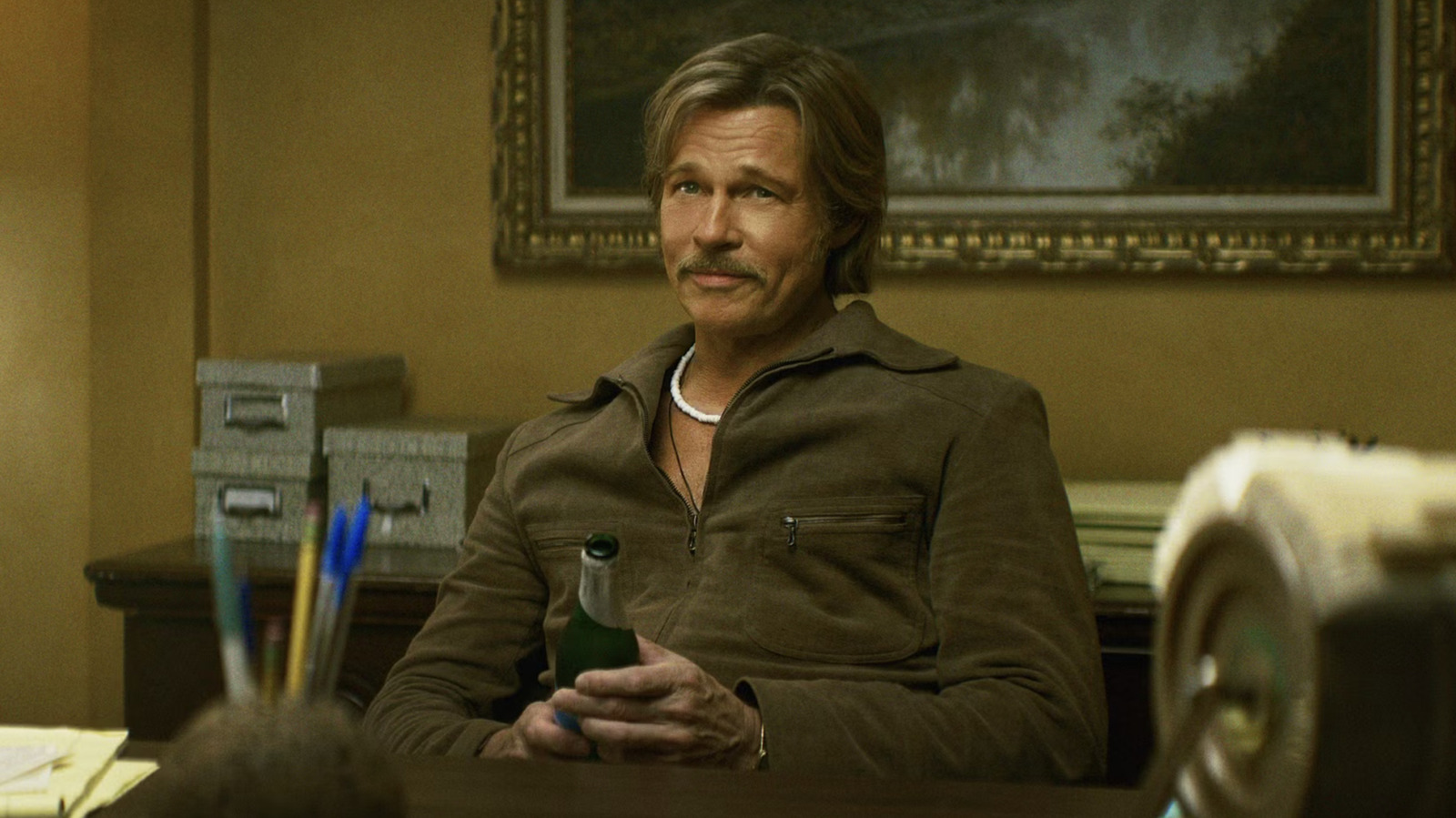
“Cliff Booth” ends on an ambiguous note. After spending much of the film attempting to quell a dispute between the blowhard insecure actor Charlie Peters (Scott Caan) and a pair of Filipino gangsters, Eddie and Fernando Verdusco (Matt Groove and JB Tadena, respectively), Cliff arranges a clandestine meeting between the brothers and himself at a bar in Hollywood. This meeting deliberately mirrors a similar encounter at the beginning of the film, in which Cliff has a couple of other ne’er do wells meet him at the New Beverly Theater, a meeting which ends with Cliff’s triumph. Cliff is similarly cocksure going into his meeting with the Verduscos, but things quickly and violently get out of hand. He does manage to kill both gangsters, but at the expense of himself being burned alive and (possibly) mortally wounded.
For the film, Tarantino has handed over the directing reins to David Fincher, and this ending is a perfect summation of Fincher’s mean-spirited satire, a final moment which is either Cliff’s lowest point or the bitter end of his story.
Cliff Booth succumbs to his movie tough-guy persona
Throughout his career, David Fincher has enjoyed making films in which his protagonists undergo a great deal of suffering. This doesn’t always mean that they’re deserving of such suffering, but Fincher does tend to have more dark, mean-spirited fun with those who are: Jack in “Fight Club,” Mark Zuckerberg in “The Social Network,” and the titular assassin in “The Killer” are all good examples of such. Cliff in “The Further Mis-Adventures of Cliff Booth” can be added to this roster, though Fincher (via writer Quentin Tarantino) is a little more affectionate toward him than some of the others.
The film begins with Cliff projecting the fictional Blaxploitation movie “Soul Brothers Die Hard,” which he clearly loves enough to have memorized some dialogue from it. The climactic line uttered by the movie’s lead is, “This don’t mean s**t to me,” which the character says as he’s bleeding out amidst a fiery blaze.
The rest of the film sees Cliff saunter through his charmed life as a jack of all trades, gallivanting from a bartending job to a demolition derby appearance. He even gets recognized by a married couple for his moonlighting work as a porn star. He’s essentially treated as an underground living legend of Hollywood, a near-mythic tough guy figure who nearly lives up to his larger-than-life persona. Yet when the Verdusco brothers violence erupts, Cliff loses control of the situation. The film smash cuts to credits as the bar the barely-alive Cliff is in rapidly catches fire, and then cuts back mid-credits to reveal Cliff, technically still alive but still stuck bleeding in the burning building, saying “This don’t mean s**t to me.” Reel life has become real life for the man, and it’s all caught up with him.
A mean ending that pays Cliff Booth’s debt
If “Once Upon a Time in Hollywood” is ultimately a fairy tale look at films and the film industry with some rough edges to it, “The Further Mis-Adventures of Cliff Booth” is the inverse, a cold satire of Hollywood and its productions which has a silver lining of affection. At the center of the film is a discussion between Cliff, Charlie, his wife Toni (Carla Gugino), and Charlie’s agent (and Cliff’s love interest) Karen Crosby (Elizabeth Debicki), who originally worked as a film critic. Karen argues that cinema is placating entertainment that can never be considered true art. In Tarantino terms, this is another instance where his characters indulge in pop culture debate, and this depiction is never intended as either endorsement or derision (after all, he’s had everyone from unrepentant killers to literal Nazis wax poetic on the movies and TV they love).
However, for Fincher, this moment feels like thematic setup for the film’s audience unfriendly, brutal, mean ending, in which our lovable (if morally questionable) hero loses. If Tarantino “purchased” the history-changing salvation of Sharon Tate in “Hollywood” through cinematic revisionism, then Fincher is using “Cliff Booth” as the payment due, a check written by Booth’s part in saving Sharon as well as by him leaning into his own legend.
To be fair, we don’t actually see Cliff die, so the ending could be seen as more sardonic. Yet its connection to the finality of “Soul Brothers Die Hard” along with the tropes of pulp and exploitation films (even Tarantino’s “The Hateful Eight,” too) heavily imply that Cliff isn’t making it out of that bar alive. It’s not a happy end, but it’s a fitting one for Cliff to go out in a blaze of almost-glory.




Leave a Reply